> ## Documentation Index
> Fetch the complete documentation index at: https://syteca.com/docs/llms.txt
> Use this file to discover all available pages before exploring further.
# Update Clients
> Update Syteca Windows, macOS, and Linux Clients automatically when the Application Server upgrades, or manually from the Management Tool with Bulk Action.
Syteca offers two ways to update Clients to a new product version: **automatically**, as soon as each Client connects to a newer Application Server, or **manually**, from the Management Tool on your schedule. The procedure is identical for **Windows**, **macOS**, and **Linux** Clients - only the post-update status indicators differ by OS.
## Recommended approach
Use **automatic updates** unless you have a specific reason to manage the schedule yourself. With automatic updates on, a Client picks up the new version the next time it connects to the Application Server after the server itself has been upgraded. No further action is needed for that Client.
Use **manual updates** when you want to control the rollout - for example, to update a small pilot group of Clients first and the rest later.
After a Client is updated, the monitored data it recorded **before** the update remains accessible.
It may not be possible to update Clients of very old versions. In that case, **reinstall** the Client instead.
## Update automatically
Turn on automatic update for a single Client, or for an entire Client group at once.
Sign in to the Management Tool as a user with the [Client Configuration Management permission for Clients](/docs/administration/users/client-permissions).
Click **Clients** in the left navigation.
On the **Clients** tab, click the Client's name in the **Client Name** column. To configure an entire group at once, switch to the **Client Groups** tab and click the group's name in the **Client Group Name** column.
Use the **Search** box and filters at the top of the page to find specific Clients (or the Search box at the top of the Client Groups page to find specific groups).
On the **Editing Client** (or **Editing Client Group**) page, on the **Properties** tab, scroll to the **Client Mode** section and select the **Update Client automatically** checkbox.
Click **Finish** in the bottom right.
The Client - or every Client in the group - updates automatically the next time it connects to an Application Server running a newer version of Syteca.
## Update manually
Manual update is a two-stage workflow: first turn **off** automatic update on the Clients you want to control, then trigger the update from Bulk Action after the Application Server is upgraded.
### 1. Disable automatic update on selected Clients
Sign in as a user with the [Client Configuration Management permission for Clients](/docs/administration/users/client-permissions).
Click **Clients** in the left navigation.
For each Client you want to manage manually, click its name in the **Client Name** column. (Or open a Client group from the **Client Groups** tab to apply the change to all Clients in the group.)
On the **Properties** tab, in the **Client Mode** section, **clear** the **Update Client automatically** checkbox.
Click **Finish** to save the changes.
### 2. Run the update after the Application Server is upgraded
First, [update the Application Server](/docs/administration/deployment/update-application-server) to the new version.
Sign back in to the Management Tool and click **Clients**.
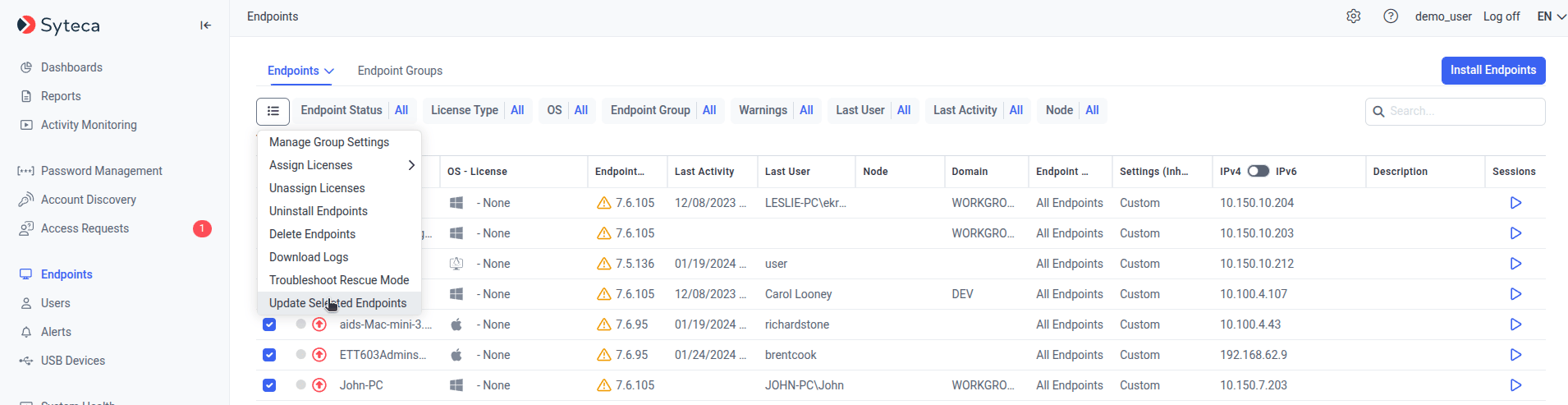
On the **Clients** tab, select the checkboxes next to the Clients you want to update.
Click **Bulk Action** in the top left, then choose **Update Selected Clients** from the menu.
The selected Clients update to the latest version.
 ## What happens to a not-up-to-date Client
A Client that's behind the Application Server version **continues to monitor user activity and send data** as normal - it just won't pick up new features or fixes until updated. Each OS shows a different post-update status indicator (and Linux and macOS have their own troubleshooting cases). For OS-specific status meanings, see:
Up-arrow and orange warning triangle indicators.
Includes Accessibility and Allow in Background fixes.
Includes Rescue mode and Troubleshoot Rescue Mode.
## Related
Per-OS reference for Windows Client operation.
Per-OS reference for macOS Client operation.
Per-OS reference for Linux Client operation.
The server upgrade that triggers Client updates.
## What happens to a not-up-to-date Client
A Client that's behind the Application Server version **continues to monitor user activity and send data** as normal - it just won't pick up new features or fixes until updated. Each OS shows a different post-update status indicator (and Linux and macOS have their own troubleshooting cases). For OS-specific status meanings, see:
Up-arrow and orange warning triangle indicators.
Includes Accessibility and Allow in Background fixes.
Includes Rescue mode and Troubleshoot Rescue Mode.
## Related
Per-OS reference for Windows Client operation.
Per-OS reference for macOS Client operation.
Per-OS reference for Linux Client operation.
The server upgrade that triggers Client updates.