> ## Documentation Index
> Fetch the complete documentation index at: https://syteca.com/docs/llms.txt
> Use this file to discover all available pages before exploring further.
# Workforce Password Management
> Syteca Workforce Password Management (WPM): give every employee a private password vault for personal work credentials, inside the same platform that secures privileged access.
## A private vault for every employee, inside the same platform
Privileged accounts aren't the only credentials your team handles. Every employee has dozens of business passwords — SaaS logins, departmental shared accounts, cloud consoles, vendor portals — that today probably live in browser autofill, sticky notes, or password managers your IT team doesn't control. That's a real attack surface and a compliance gap.
**Workforce Password Management (WPM)** is Syteca's answer: every user gets a **private vault** for their own work credentials, inside the same platform that secures your privileged accounts. WPM secrets are hidden from everyone else by default — even the user's manager — unless the owner explicitly shares them. So an employee can keep their own SaaS logins private, share team credentials with their teammates, and never have to leave Syteca to do either.
**Use Workforce Password Management when you want to:**
* Replace consumer password managers (LastPass, 1Password, browser autofill) with a single corporate-controlled platform.
* Give every employee a private vault — not just privileged-access users.
* Let teams share business credentials safely (departmental SaaS accounts, vendor portals) without sending passwords in chat or email.
* Audit how shared business passwords are used, the same way you audit privileged accounts.
* Consolidate PAM and employee password management onto one platform and one license.
WPM is available to any user of Syteca Connection Manager, including those **without** the **Management Tool Access** permission — so an end user with no admin role still gets a vault.
Users reach this through the **Add Secret** button in Connection Manager: clicking it opens the Management Tool login in the browser, where they sign in and manage their WPM secrets in their own folder on the **Password Management** page. A user without the Management Tool Access permission gets limited access — to the Password Management page only.
This works in the desktop Syteca Connection Manager and, in a similar way, directly from the Management Tool using [Syteca Web Connection Manager](/docs/pam/access/web-connection-manager).
## 1. Allow a PAM user without Management Tool access to use WPM
To let a PAM user who does **not** have the Management Tool Access permission create and manage their own WPM secrets:
Sign in to the Management Tool as a user with both the [Management Tool Access](/docs/administration/users/administrative-permissions) and [User Management](/docs/administration/users/administrative-permissions) administrative permissions.
Click **Users**, then **Add User** to [add a new user](/docs/administration/users/users#add-a-user), or click the **Edit User** icon to modify an existing one.
Only users added individually to the Management Tool can create secrets and folders. Users who belong only to an Active Directory group do not have this permission. For more information, see the [Management Tool issues and error messages](/docs/resources/troubleshooting/management-tool-troubleshooting) page.
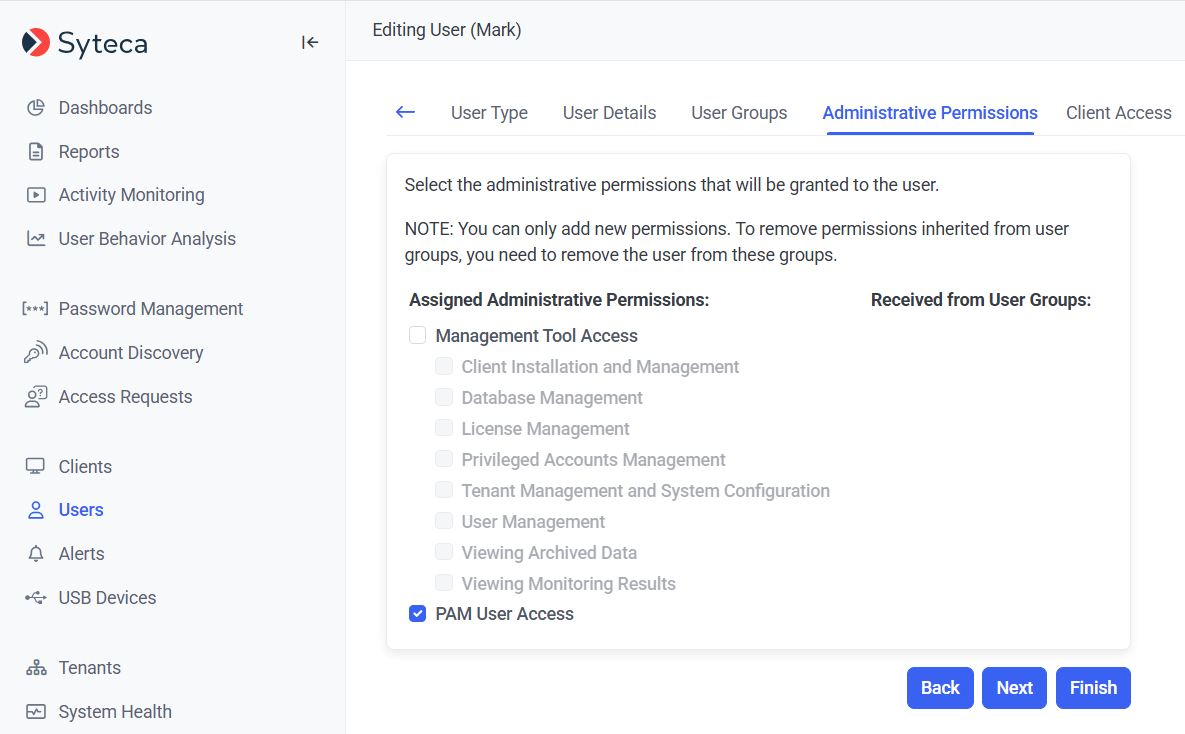
On the **Administrative Permissions** tab, grant the [PAM User Access permission](/docs/administration/users/administrative-permissions#privileged-accounts-management). It can also be inherited from a user group that has it (shown in the "Received from user groups" column) — for example, the **PAM Users** group.
 ## 2. Create WPM secrets as a PAM user
To create and manage your own private WPM secrets:
Sign in to a Client computer with Syteca Connection Manager enabled, as a Management Tool user with either the **Management Tool Access** or the **PAM User Access** permission.
Open Syteca Connection Manager (for example, via the **Syteca Remote Access** icon).
Click **Add Secret** in the bottom left.
On the Management Tool login page that opens in your browser, enter your **Login** and **Password**.
The **Login** field is filled in automatically and can't be changed.
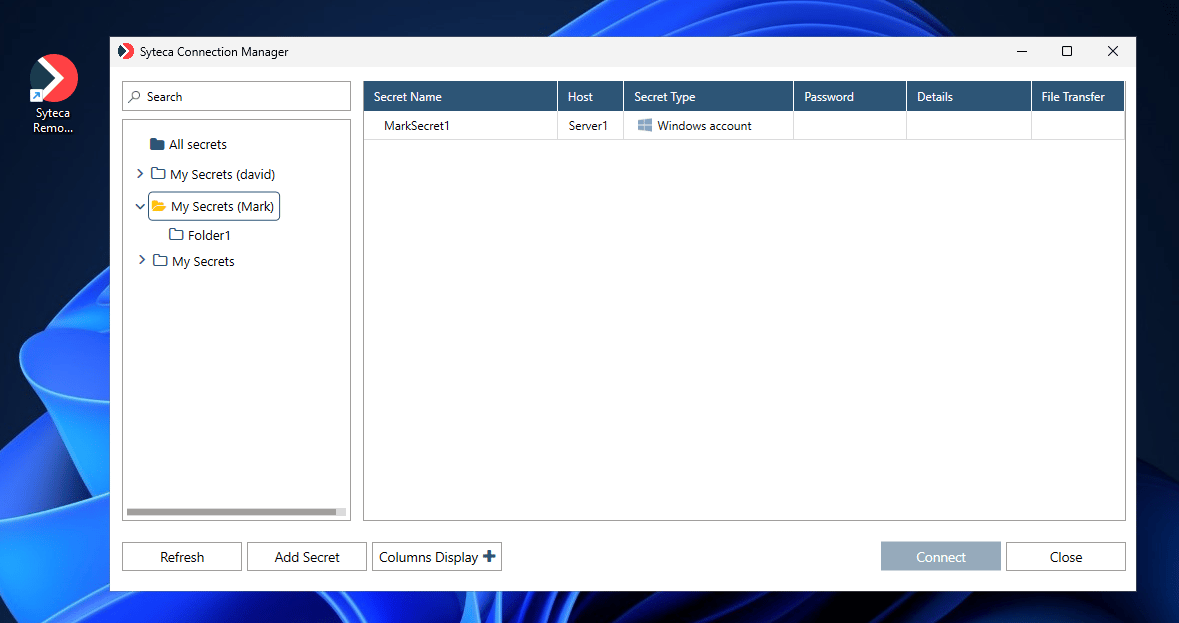
On the **Password Management** page, your own WPM folder is the current folder, named **My Secrets (\)**. You can add WPM secrets and sub-folders to it.
Other PAM users' WPM folders appear too, but only if they've shared at least one WPM secret with you. For owners in an Active Directory domain, the folder name includes the domain: **My Secrets (\\\\)**.
Edit an existing WPM secret, or click **Add** to create one. To let other users use it, share it on the **Permissions** tab in the usual way. Sub-folders can also be added.
After saving, the secret appears in your **My Secrets (\)** folder on the Password Management page and in Connection Manager, where you connect with the **Connect** button. It stays hidden from other users (except the default **admin**) unless you've shared it.
## 2. Create WPM secrets as a PAM user
To create and manage your own private WPM secrets:
Sign in to a Client computer with Syteca Connection Manager enabled, as a Management Tool user with either the **Management Tool Access** or the **PAM User Access** permission.
Open Syteca Connection Manager (for example, via the **Syteca Remote Access** icon).
Click **Add Secret** in the bottom left.
On the Management Tool login page that opens in your browser, enter your **Login** and **Password**.
The **Login** field is filled in automatically and can't be changed.
On the **Password Management** page, your own WPM folder is the current folder, named **My Secrets (\)**. You can add WPM secrets and sub-folders to it.
Other PAM users' WPM folders appear too, but only if they've shared at least one WPM secret with you. For owners in an Active Directory domain, the folder name includes the domain: **My Secrets (\\\\)**.
Edit an existing WPM secret, or click **Add** to create one. To let other users use it, share it on the **Permissions** tab in the usual way. Sub-folders can also be added.
After saving, the secret appears in your **My Secrets (\)** folder on the Password Management page and in Connection Manager, where you connect with the **Connect** button. It stays hidden from other users (except the default **admin**) unless you've shared it.
 ## Related
The full secret configuration reference.
How sharing and Role Types work.
Where WPM folders appear in the tree-view.
Manage WPM secrets from the browser instead of the desktop app.
## Related
The full secret configuration reference.
How sharing and Role Types work.
Where WPM folders appear in the tree-view.
Manage WPM secrets from the browser instead of the desktop app.