Privileged accounts are essential to modern IT environments, but they also introduce significant security risks. With credential abuse often cited as the primary initial access vector, organizations must change their approach to access management.
This article addresses the challenges of privileged access management (PAM) and equips IT administrators, security architects, and network engineers with actionable insights into access control and how Syteca PAM can help. You’ll learn about our platform’s key capabilities and how it can protect your environment.
Key takeaways:
- Privileged access has become a critical security priority as identity-driven attacks, credential abuse, and human error continue to expose organizations to serious risk.
- Hybrid IT environments make privileged access harder to control by increasing account sprawl, reducing visibility, and creating inconsistencies across systems and workflows.
- Poor privileged access management can lead to excessive permissions, shared account misuse, static credentials, and limited oversight of privileged activity.
- An effective PAM strategy reduces these risks by enforcing least privilege, protecting credentials, automating access controls, and maintaining reliable audit trails.
- Syteca PAM helps organizations secure privileged accounts through account discovery, password management, approval workflows, session monitoring, and real-time incident response capabilities.
- With scalable deployment, flexible integrations, and support for complex infrastructures, Syteca PAM improves both security resilience and operational efficiency.
Addressing the сhallenges of PAM
According to Verizon’s 2026 Data Breach Investigations Report, 62% of all breaches involve a human element such as error, privilege misuse, credential compromise, or social engineering.
This indicates that human behavior remains one of the most exploited attack vectors, making it essential for organizations to enforce least privilege and continuously monitor privileged sessions. In practice, PAM helps reduce the impact of the human element by limiting what privileged users can access and do.

At the same time, identity is now considered the new security perimeter, with identity attacks accounting for 32% of all breaches, according to IBM’s X-Force 2026 Threat Intelligence Index.
Key PAM challenges
Privileged accounts, which provide elevated access to critical systems and data, are frequently targeted by malicious actors. Meanwhile, regulatory requirements and operational complexities make managing these critical accounts more challenging.
As organizations navigate increasingly complex IT ecosystems, they encounter many difficulties in managing and securing privileged access.
Hybrid account sprawl
A hybrid infrastructure not only increases the number of users but also multiplies the number of privileged identities. When organizations spread workloads across different environments, privileged access becomes fragmented across on-prem systems, cloud platforms, SaaS apps, remote endpoints, and third-party tools. This makes it harder to maintain a centralized view of privileged identities. According to IBM’s 2025 Cost of a Data Breach Report, cross-environment breaches cost up to 25% more and take an average of 276 days to identify and contain, versus 217 days for on-premises breaches.
Account sprawl in hybrid infrastructures also creates consistency issues. Different environments often use different provisioning methods, approval flows, and logging practices, so dormant admin accounts, excessive permissions, and unmanaged access can accumulate faster than security teams can review them.
Credential-focused attacks
Sophisticated cyberattacks, including ransomware and phishing campaigns, often exploit privileged users’ credentials to maximize their impact. Verizon’s 2026 Data Breach Investigations Report states that 39% of system intrusions involve stolen credentials.
When threat actors compromise an administrator, domain, cloud, or service account, they can move laterally, disable protections, access sensitive repositories, and create persistence without relying on noisy malware at every step. Detecting such attacks can be difficult, as attackers use legitimate credentials and sessions may appear normal without proper monitoring controls.
Rising insider threats
On average, each organization experienced 25 insider-related incidents in 2025, up from 23 in the preceding year, according to the 2026 Cost of Insider Risk Global Reports by the Ponemon Institute. Whether malicious or accidental, insider threats pose a unique challenge, as they originate within trusted environments.
Privileged insiders are especially dangerous because their elevated access shortens the path to impact. They may not need to exploit a vulnerability or phish another employee to reach sensitive systems, and the longer excessive privileges persist, the easier it becomes to exfiltrate data, alter configurations, or hide traces of misuse.
Explore Syteca in action.
See how the Syteca platform can minimize insider threats.
Regulatory pressure
Weak PAM increases both security risk and regulatory exposure. The GDPR, NIS2, HIPAA, and numerous other cybersecurity standards, laws, and regulations mandate robust access controls and audit trails to ensure data security and accountability. If privileged activity is not centralized, logged, and attributable to a specific identity and approval context, an organization can struggle to demonstrate compliance during an audit or investigation.
Failure to comply with regulatory requirements can result in reputational damage, significant financial penalties, and legal prosecution. For example, the GDPR imposes administrative fines of up to €20 million or 4% of an organization’s total worldwide annual turnover, whichever is higher, for the most serious violations.
Operational inefficiencies due to manual processes
Manual privileged access workflows create friction with access requests, approvals, privilege elevation, credential rotation, and session review. When these tasks rely on email chains, spreadsheets, disconnected tickets, or human memory, IT teams spend more time administering access and less time verifying whether access is actually appropriate. The result is slower response times and a higher probability of overprovisioning, stale privileges, and missed revocations.
The bigger issue is that manual process gaps often turn into security gaps. If privileged access is not provisioned, reviewed, and removed through repeatable controls, organizations struggle to enforce policy consistently across environments and at scale. Automation reduces both delay and variance: it standardizes approvals, limits standing access, and creates reliable records that operations and security teams can act on quickly.
Given the complexity of these challenges, it is crucial that organizations adopt a comprehensive and proactive approach to privileged access management.
Key risk factors of poor access management
Effective access management requires identifying and addressing critical risk factors that threaten the security and integrity of privileged accounts. These vulnerabilities, if left unmanaged, can create significant opportunities for malicious actors to exploit. Here is an outline of the key risk factors:
Unmanaged privileged accounts
Your organization may struggle to identify and secure all privileged accounts, particularly orphaned and dormant accounts that attackers can exploit.
Lack of visibility into privileged user activity
Without comprehensive user activity monitoring, you lack insight into how your critical assets are being handled, leaving potentially harmful user actions undetected.
Shared administrative accounts
Sharing admin accounts compromises accountability and increases the likelihood of credential interception and unauthorized access.
Insufficient access controls
Weak or outdated access control mechanisms fail to enforce the principle of least privilege, exposing your sensitive systems to unnecessary risks.
Static credentials for privileged accounts
Static passwords that remain unchanged for extended periods present a significant vulnerability, providing cybercriminals with numerous opportunities for brute-force attacks and other exploitations.
Manual password management
Managing passwords manually is not only time-consuming but also prone to human error, leading to potential security gaps and inefficiencies.
By addressing these challenges and mitigating key risks, a robust privileged access management solution can serve as the cornerstone of your IT security. Syteca PAM is purpose-built to tackle these issues, providing your organization with the tools necessary to safeguard privileged access, gain visibility into sessions, maintain compliance, and enhance operational efficiency.
Securing every interaction with Syteca PAM
Syteca is a modern PAM solution enhanced with identity threat detection and response (ITDR) to secure access throughout the session.
Syteca PAM offers a comprehensive, adaptive approach to safeguarding privileged access, ensuring every interaction is secure, compliant, and efficient.
Minimize security risks
Protect critical systems and data proactively by enforcing the principle of least privilege, monitoring privileged users’ activities, and eliminating vulnerabilities posed by shared accounts and static credentials.
Streamline compliance
Leverage Syteca’s rich feature set to meet the requirements of numerous cybersecurity standards, laws, and regulations, including the GDPR, NIS2, DORA, HIPAA, NIST 800-53, FISMA, PCI DSS, and many others.
Reduce cybersecurity costs
Avoid both direct and indirect losses by preventing security incidents. Reduce the workload for IT and security teams, freeing up resources for other priorities and optimizing access management workflows.
Deploy quickly at scale
Deploy rapidly and scale with ease. Syteca PAM ensures seamless integration into existing IT environments without disrupting your operations.
Key areas where Syteca PAM delivers value
Syteca PAM provides great value by addressing the foundational elements of privileged access management. With its advanced tools and capabilities, here’s how the platform excels in three key domains:
Gain full control over privileged accounts and sessions
Identify unmanaged accounts and control who uses them. Includes session monitoring to prevent misuse and simplify compliance audits.
Elevate the security of privileged account credentials
Securely store, share, and rotate credentials using robust encryption, time-based restrictions, manual approvals, and a checkout process.
Secure remote access for privileged users and third parties
Secure and trace remote employee/vendor access to critical endpoints via temporary permissions, 2FA verification, session monitoring, and audit trails.
Organizations are increasingly pushing the boundaries of traditional PAM implementations to address complex security challenges in dynamic IT environments:
Many early adopters of PAM — the large enterprises — are looking to increase their PAM maturity to extend beyond basic use cases. To address these advanced needs, vendors have made further investments in capabilities such as secrets management, JIT PAM, privileged threat detection and reporting of privileged activities and management of privileges in multicloud environments.
Gartner®, Magic Quadrant for Privileged Access Management (subscription required)
This underscores the importance of choosing a PAM solution like Syteca that integrates these advanced capabilities.
Main capabilities of Syteca PAM
Syteca offers an extensive suite of capabilities designed to strengthen privileged access security, streamline management, and enhance operational efficiency. Here’s an overview of its core capabilities:
Identity and access management
Privileged account discovery
Workforce password management
Privileged session management and monitoring*
Privileged account discovery
With Syteca PAM, you can discover and onboard unmanaged accounts scattered across your IT environment from a centralized platform:
- Rule-based scanning for privileged user and service accounts across multiple domains.
- Flexible scheduling of account discovery scans.
- Bulk onboarding for discovered accounts.
- Email notifications about newly detected accounts.
Identity and access management
Syteca enables you to create efficient workflows for in-house teams, remote workers, and third-party vendors while safeguarding your critical systems and data with the following privileged access management capabilities:
- Endpoint access control to secure workstations and servers.
- Multi-factor authentication (MFA) to verify users.
- One-time passwords for temporary access to endpoints.
- Secondary authentication to differentiate user activity under shared accounts.
- Access request and approval workflows to manually allow access to critical endpoints.
- Time-based restrictions to enable just-in-time access provisioning.
Workforce password management
Syteca PAM allows you to centralize password and SSH key management and protect them against unauthorized use and compromise with the following features:
- Password vault for storing encrypted secrets.
- Password sharing for secure, effective collaboration across teams.
- Automated rotation for updating passwords after a specified period of time.
- Password check-out to ensure that secrets are used one at a time.
- Recording of sessions that involve the use of secrets.
- Role-based access for using and managing secrets.
- Application credentials broker to integrate Syteca with your IT systems and securely retrieve secrets for applications.
Privileged session management and monitoring*
You can also track and record privileged user actions on your endpoints and servers to enhance accountability and ensure adherence to security policies with these Syteca features:
- Continuous monitoring for uninterrupted oversight.
- Alert-triggered recording to capture only the most critical activity.
- Advanced metadata search to streamline audits.
- Activity reports and dashboards for informative insights into your threat landscape.
- Automated alerts and incident response for prompt threat detection and mitigation.
- Thorough audit trails to support compliance and forensic investigation.
Note: *The Syteca ITDR module must be enabled for privileged session management and monitoring
Syteca’s technical architecture
Syteca PAM uses a modular architecture that delivers secure, scalable privileged access management across enterprise environments.
Core system components
Syteca’s main system components include:
The central backend hub that coordinates communication between system components and handles configurations, permissions, and core PAM processes.
A web-based administrative console used to configure policies, manage access, and monitor privileged activity from a single interface.
Endpoint agents that enable session monitoring, policy enforcement, and control over privileged accounts and user activity.
A dedicated component that stores privileged credentials in a secure vault, brokers connections to target systems, and supports controlled credential sharing.
A third-party component that manages and stores user activity monitoring data.
Integration capabilities
Syteca integrates with ticketing systems, SIEM platforms, and SSO providers to support smoother workflows, centralized visibility, and faster incident response. It also supports API-based integrations for automation and secure access to stored secrets.
Platform support
Syteca PAM operates on Windows systems and supports the following connections:

Syteca ITDR supports an even broader range of environments, including Windows, Linux, macOS, UNIX, X Window System, Citrix, Wayland, VMware Horizon, Microsoft Hyper-V, Amazon WorkSpaces, and Azure Windows Virtual Desktops.
Deployment and initial setup
Deploying Syteca PAM takes minimal time and effort. For detailed guidance on installing and configuring Syteca, check out our technical white paper, refer to our documentation, or contact our support team at [email protected].

How Syteca PAM benefits administrators and end-users
Syteca is continuously working on advancing security and improving the user experience. The table below explains several privileged access management benefits and how Syteca PAM empowers administrators with robust access control and monitoring capabilities while offering end users a seamless and secure experience.
Admin perspective
- Automate scans to detect privileged accounts and service accounts across Windows and Linux endpoints.
- Onboard discovered accounts and protect their secrets in an encrypted Password Vault.
- Configure further scanning and receive email notifications about newly detected accounts.
End-user perspective
- Access onboarded accounts with configured permissions for secure workflows.
Admin perspective
- Provide users with access to endpoints without exposing passwords.
- Automate password rotation for enhanced security.
- Manage workforce passwords and enable users to securely store and share their personal credentials.
- Store user credentials in a protected Password Vault.
End-user perspective
- Access endpoints securely without exposing or managing credentials.
- Benefit from automatically changed passwords.
- Safely and effortlessly share personal credentials within teams.
Role-based access control for secret management
Admin perspective
- Save time and prevent excessive privileges by providing users with a pre-defined set of permissions based on their roles.
End-user perspective
- Operate securely within assigned roles and receive permissions promptly without needing to contact administrators.
Access approval workflows
Admin perspective
- Set up access request and approval workflows to provide on-demand access to critical endpoints.
- Enable automated notifications for streamlined access approvals.
- Restrict access to critical endpoints during non-working hours to minimize risks.
End-user perspective
- Submit access requests via an intuitive interface and track their statuses for clarity.
- Quickly request temporary access to critical systems that are subject to admin approval.
Just-in-time privileged access management
Admin perspective
- Grant temporary credentials for time-bound and endpoint-specific tasks.
- Automatically revoke credentials after each session to reduce the risk of misuse.
- Provide third-party users with one-time passwords to reduce the attack surface.
End-user perspective
- Receive temporary access to endpoints in a timely manner.
Admin perspective
- Identify individual users of shared accounts to ensure accountability.
End-user perspective
- Effortlessly log in with personal credentials when accessing shared accounts.
Multi-factor authentication (MFA)
Admin perspective
- Verify users accessing privileged accounts or the Management Tool with tools like Google and Microsoft Authenticator.
End-user perspective
- Seamlessly log in with an OTP passcode sent to a personal device.
Admin perspective
- Provide exclusive access to secrets to prevent their simultaneous use.
- Automatically rotate passwords upon check-in to ensure fresh credentials.
- Forcibly check passwords back in to immediately disconnect users engaging in suspicious activity.
- Monitor the status of checked-out passwords in real time.
End-user perspective
- Gain on-demand access to critical systems without delays, ensuring smooth workflows.
Agentless web-based access
Admin perspective
- Provide remote users and vendors easy-to-use access that launches secrets via the browser without requiring the Syteca software agent to be installed.
End-user perspective
- Get convenient and quick access through the browser, on any computer.
Admin perspective
- Enable convenient and secure file transfer for users via secrets (supports file transfer protocols such as SFTP, SCP, and FTP, depending on the secret type).
End-user perspective
- Easily transfer files to a remote computer via the Syteca Connection Manager without connecting to it directly.
Admin perspective
- Automatically track user sessions when secrets are used.
- Analyze user sessions in real time using the Session Player.
- View all logged activity associated with secrets for comprehensive auditing.
- Monitor user activity without violating privacy laws with the help of sensitive data masking and monitoring data pseudonymization features.
End-user perspective
- Continue working without interruption during session recording.
- Be confident that your personal data is invisible to investigators.
User activity alerts & incident response (when the UAM module is activated)
Admin perspective
- Use default alerts or set custom ones.
- Receive real-time notifications about unusual user activity.
- Promptly block suspicious sessions based on pre-configured alerts.
- Send warning messages to users to notify them about undesired actions.
End-user perspective
- Stay informed about security policy violations.
Syteca PAM strikes a balance between robust capabilities for administrators and a frictionless experience for end users, ensuring both security and efficiency.
Syteca PAM use cases
Syteca PAM is designed to address a wide range of challenges organizations face when managing privileged access. This section explores various real-world privileged access management use cases where Syteca PAM can empower organizations to protect critical resources, streamline operations, and comply with regulatory requirements.
Use case #1. Proactive management of all privileged accounts
Organizations face risk from unmanaged privileged accounts and insider threats. These issues expose them to security breaches, operational inefficiencies, and compliance violations.
- Account discovery. Syteca scans the network and detects privileged accounts, including shadow ones.
- Account onboarding per security policies. Accounts are onboarded to the encrypted vault per the organization’s security policies on password rotation, character requirements, mandatory MFA, etc.
- Role-based access control. The number of users who can view or modify privileged account credentials is limited; only senior IT admins can manage these accounts, and all actions are logged for auditing purposes.
- Real-time session monitoring. Privileged sessions are recorded, and alerts are generated for suspicious user activity, ensuring proactive threat detection.
All privileged accounts are securely managed from discovery to deletion, insider threats are mitigated, and operational inefficiencies are reduced, in accordance with privileged access management best practices.
Use case #2. Securing third-party access
Almost every company needs to work with external contractors (e.g., third-party database administrators), but allowing them to access critical systems securely should be done without exposing the entire infrastructure.
- Jump server. External users access the isolated system via a jump server protected by a ticketing system.
- Ticketing system integration. Third-party administrators must enter a valid ticket number to connect to a sensitive endpoint.
- Windows Shell replacement. Users interact exclusively through the Syteca Connection Manager, with the Windows Shell replaced to prevent access to the desktop environment. Only the Syteca Connection Manager is visible and usable.
- Secrets management. Password checkout and rotation minimize credential exposure.
- Access time restrictions. One-time passwords and time limitations allow third-party access to be automatically revoked once it’s no longer needed.
- Session recording. Contractor activities are monitored and recorded in real time for security and compliance purposes.
The company achieves secure and auditable external access, protecting sensitive infrastructure while maintaining operational efficiency.
Use case #3. Industry-specific access control
A hospital wants to ensure patient data in its electronic health record (EHR) system is secure and accessible only to authorized personnel during working hours while maintaining compliance with data protection regulations.
- Endpoint access management. Granular access provisioning, MFA, and secondary authentication secure access to sensitive health records.
- Secrets management. Only authorized users can access EHR systems via secrets, with usage restricted to their work hours.
- Audit trails. All actions with secrets and sensitive healthcare data are recorded, ensuring compliance with HIPAA, the GDPR, and other relevant cybersecurity laws and regulations.
The hospital ensures secure, compliant access to patient data while simplifying oversight with detailed audit trails.
By addressing diverse challenges, Syteca PAM empowers organizations to protect critical resources and streamline operations effectively.
Future-proof privileged access security with Syteca PAM
Syteca PAM helps you proactively solve the challenges associated with privileged access management, from mitigating insider threats to streamlining compliance with stringent regulations. By securing identities and focusing on what happens after login, Syteca protects you from current and future threats.
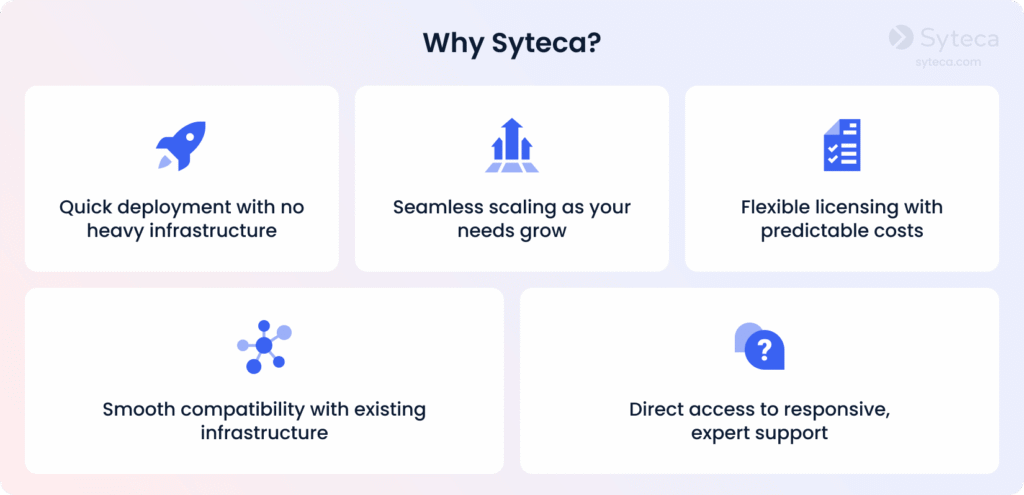
Whether securing third-party access, protecting sensitive data, or navigating complex hybrid environments, Syteca PAM can equip your organization with a comprehensive, scalable, and adaptive solution to meet modern IT security demands.
Want to try Syteca?
Request access to the online demo!
See why clients from 70+ countries already use Syteca.
FAQ
Privileged access management (PAM) is a cybersecurity framework and set of technologies for controlling and securing accounts, users, and activities that have elevated access to critical systems and sensitive data. PAM typically includes controls such as credential vaulting, multifactor authentication, just-in-time access, and session monitoring to reduce the risk of misuse or compromise. In practice, PAM helps organizations limit unnecessary access and maintain visibility into what privileged users do during sensitive sessions.
Identity and access management (IAM) manages authentication and access for all users, applications, and services across an organization, while PAM focuses specifically on privileged accounts and elevated access. IAM is mainly concerned with who should have access, whereas PAM adds stricter controls over how, when, and under what conditions privileged access is granted.
The two work together: IAM provides broad identity governance, and PAM adds deeper protection for high-risk accounts that can reach critical systems and data.
PAM supports regulatory compliance by enforcing least-privilege access and restricting sensitive systems to authorized users for approved purposes only. PAM solutions like Syteca also create detailed logs, reports, and session records that show who accessed what, when, and why to assist during audits and investigations. In addition, Syteca PAM reduces compliance risks by differentiating user activity under shared accounts, improving accountability, and giving organizations stronger evidence that privileged activity is controlled and traceable.