Attackers no longer break in — they log in. Traditional privileged access management (PAM) solutions alone can’t protect your organization from credentials misuse once attackers are inside your security perimeter. PAM solutions control who can access your systems, but they have a critical blind spot: they can’t see what happens next.
In this article, we’ll explore why traditional PAM solutions aren’t enough; the types of identity-based attacks that exploit PAM limitations; and how identity threat detection and response (ITDR) fills critical security gaps.
Key takeaways
- Identity is the new perimeter. Attackers can get inside your systems using valid credentials.
- Traditional PAM solutions aren’t enough for combating modern identity threats. PAM controls access, but it lacks real-time visibility into what happens after login.
- Modern attacks easily bypass PAM controls. Attackers can use MFA fatigue, session hijacking, credential abuse, and other techniques to exploit PAM security gaps.
- ITDR fills these critical gaps. It delivers continuous session monitoring, anomaly detection, and automated incident response.
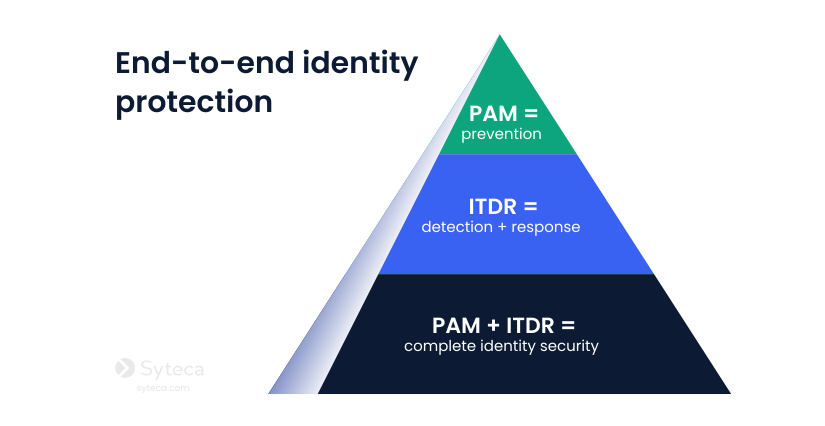
- When merged, PAM and ITDR ensure end-to-end protection of digital identities.
Why traditional PAM is no longer enough
Traditional PAM solutions were originally designed to control access to sensitive systems. At its core, PAM helps organizations determine who is allowed to access which systems, accounts, and resources. To govern these decisions, PAM offers tools to securely store privileged credentials in a vault, enforce MFA, rotate passwords, and control access requests.
For on-premises environments with a relatively small number of IT administrators and well-defined privilege boundaries, this model works well. Access is centralized, identities are mostly static, and privileges are granted to a limited group of trusted users.
However, the majority of modern organizations operate very differently. Privileges are no longer limited to admins — they are spread across cloud environments, DevOps pipelines, third-party vendors, service accounts, APIs, and remote employees. In these dynamic and decentralized environments, simply managing access is no longer sufficient, as identities can be abused after access is granted.
Traditional PAM tools struggle to monitor live sessions or detect malicious behavior in real time. In other words, PAM can only manage who gets in, not what they do once inside your perimeter.
Types of attacks that can’t be stopped by PAM alone
Here are several common threat scenarios where PAM by itself often falls short:
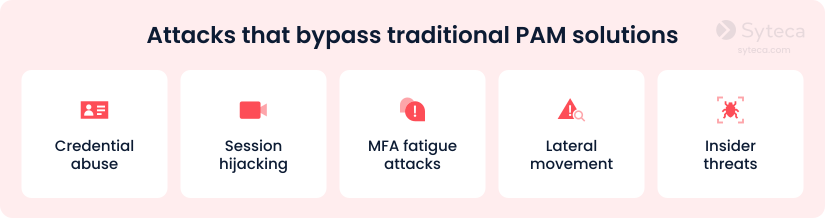
Credential abuse
According to Verizon’s 2025 Data Breach Investigation Report, 20% of organizations that have suffered a breach report that it involved abuse of credentials. Attackers can obtain valid logins from dark-web dumps, via phishing, or through third-party breaches. Then, they simply log in as authorized users, bypassing traditional PAM defenses entirely and acting silently.
Real-life case:
In 2024, attackers exploited stolen Snowflake customer credentials to gain access to dozens of high-profile organizations, including Ticketmaster, Santander, AT&T, and others. The attackers simply authenticated themselves using legitimate credentials harvested through infostealer malware, and PAM treated them as trusted users.
Session hijacking
PAM protects the credential lifecycle (password complexity, MFA enforcement, credential rotation). However, once a user successfully authenticates with MFA and receives a session token, PAM’s job is done. Attackers increasingly bypass passwords altogether by targeting tokens, API keys, and authentication artifacts, as these can be stolen or intercepted.
Real-life case:
In 2024, attackers exploited stolen Snowflake customer credentials to gain access to dozens of high-profile organizations, including Ticketmaster, Santander, AT&T, and others. The attackers simply authenticated themselves using legitimate credentials harvested through infostealer malware, and PAM treated them as trusted users.
MFA fatigue attacks
Instead of breaking MFA, attackers often bombard users with repeated login or password reset attempts, hoping that at 2 AM, an annoyed user will finally tap “Approve” just to make the pop-ups stop. While PAM solutions enforce MFA at login, they can’t detect if an employee is tricked into approving an attacker’s login.
Real-life case:
In 2024, attackers exploited stolen Snowflake customer credentials to gain access to dozens of high-profile organizations, including Ticketmaster, Santander, AT&T, and others. The attackers simply authenticated themselves using legitimate credentials harvested through infostealer malware, and PAM treated them as trusted users.
Lateral movement
PAM excels at privileged account security – it protects access for initial entry. However, it cannot detect post-authentication attacks. Once inside your network, cybercriminals with low-level legitimate credentials can escalate privileges and move laterally through your systems.
Real-life case:
The Change Healthcare attack in February 2024 started off with compromised credentials on a remote-access portal. From there, attackers moved laterally for about nine days, exfiltrated large volumes of protected health information, and deployed ransomware that disrupted billing and prescription services nationwide. It remains the biggest data breach in U.S. healthcare history to date.
Insider threats
Not all threats come from external hackers. Sometimes the “attacker” is a legitimate insider — a disgruntled IT admin, a developer preparing to join a competitor, or anyone with the intent to abuse privileges. If an employee with authorized access decides to willfully steal data or sabotage systems, PAM solutions alone won’t be able to detect it.
Real-life case:
In August 2025, Elon Musk’s xAI filed a lawsuit against a former engineer, accusing them of stealing the company’s most sensitive secrets. The ex-employee allegedly “willfully and maliciously” exported xAI’s confidential information and trade secrets from a company-issued laptop onto his personal systems. He later joined OpenAI as an engineer, raising questions about whether the trade secret theft was intentional or opportunistic.
Across all of these scenarios, the pattern is the same: nothing technically “breaks.” There is no brute force, no vault compromise, no failed MFA challenge. Attackers log in with valid credentials, operate inside approved sessions, and behave just enough like regular users to avoid detection.
What should you do then?
You must close the gaps in your identity security strategy with identity threat detection and response (ITDR). Such solutions can help you monitor identity behavior after login, detect unusual activity, and respond to incidents while they are still unfolding — not weeks later during a forensic examination.
ITDR: Visibility, detection, and response
Gartner first introduced the term “ITDR” in 2022, defining it as “a set of security practices and technologies designed to detect, investigate, and respond to threats targeting digital identities within an organization”.
In essence, ITDR delivers continuous monitoring, anomaly detection, and incident response. ITDR assumes that some attackers can bypass PAM defenses and focuses on detecting and disrupting misuse of identities in real time.
“Identity Threat Detection and Response (ITDR) is a class of security solutions designed to proactively detect, investigate, and respond to identity-related threats and vulnerabilities in an organization’s IT environment. ITDR solutions focus on protecting digital identities and infrastructure against a variety of attacks by threat actors.”
KuppingerCole, Identity Threat Detection and Response (ITDR): IAM Meets the SOC.
Notably, Gartner and other analysts now recommend that privileged access security programs include ITDR by design, not as an afterthought. Industry adoption reflects this: the ITDR market is booming, with projections of over 21% annual growth as organizations race to close the identity security gap.
Crucially, upcoming regulations will reinforce this shift. Cybersecurity standards no longer stop at “prevent unauthorized access”; they explicitly require monitoring and response. For example, the NIS2 directive mandates that organizations implement threat detection processes and report incidents to authorities within 24 hours of detection — which means detecting them quickly in the first place. DORA similarly requires robust operational monitoring and timely incident response. The GDPR indirectly stresses early detection, as failing to identify and report a breach promptly can result in substantial fines.
The message is clear: controlling access alone isn’t enough. You must continuously watch for signs of identity compromise and be ready to act fast.
Key ITDR capabilities
So what exactly does ITDR entail? ITDR provides continuous, identity-focused threat visibility and automated response. It’s the missing puzzle piece that addresses the blind spots we’ve outlined above. Think of it this way: PAM controls access, while ITDR controls what happens after access is granted. ITDR solutions typically incorporate the following capabilities:
Continuous session monitoring
ITDR tools continuously capture and log user activity across privileged and non-privileged sessions, creating a detailed forensic record of what actually happens after access is granted. This includes recording on-screen activity along with metadata, such as active apps, opened URLs, keystrokes, file uploads.
By establishing baselines for typical identity behavior, ITDR can flag anomalies — e.g., a user logging in from a new country at 3 AM, an employee suddenly accessing endpoints they never accessed before, or an admin creating an unusually large number of new privileged accounts.
Automated threat response
A critical aspect of ITDR is the ability to take quick action when a threat is detected. This might include automatically killing suspicious sessions, disabling a compromised account, rotating credentials, or sending an alert to a SIEM system to trigger an incident response procedure.
ITDR solutions often provide detailed activity logs, reports, or even full session video recordings for later investigation. By capturing “who did what and when”, ITDR provides the evidence needed to understand the scope of an incident and why it occurred.
Altogether, all these ITDR capabilities ensure holistic identity protection. Each function builds on the previous one — from visibility and detection to containment and investigation.
Syteca: PAM and ITDR converged
Future-proof your organization’s cybersecurity.
The Syteca platform converges privileged access management with natively built-in identity threat detection and response. It eliminates the gaps between access control and threat detection, delivering comprehensive visibility into all privileged activity.
PAM capabilities
prevention & control
- Privileged account discovery. Find and onboard all privileged accounts across your environment.
- Centralized credential vault. Securely store, share, and rotate passwords and SSH keys.
- Credential injection. Keep passwords completely out of end users’ sight and knowledge.
- Just-in-time access. Provide temporary privileged access on an as-needed basis.
- Approval workflows. Manually approve or deny access to highly sensitive endpoints.
- Agentless session brokering. Users can connect to your systems without deploying agents on their endpoints.
ITDR capabilities
detection & response
- User activity monitoring. Continuously record and analyze user sessions after login.
- Detailed logging. Get rich metadata alongside recordings: URLs, apps, keystrokes, and more.
- Real-time alerts. Use default or custom alerts to receive instant notifications of abnormal activity.
- Automated incident response. Terminate a session, block users, or send them a warning message.
- USB activity monitoring. Detect, log, and block the use of USB storage devices across all endpoints.
- Forensic-ready session recording. Record every session and export them as needed.
Syteca benefits
- Unified architecture: No need to juggle separate PAM and monitoring tools — reduces complexity and ensures there are no gaps between access control and threat detection.
- Fast deployment, flexible pricing: Pay only for the features you need and deploy Syteca within a day.
- Broad environment support: Works across on-prem servers, cloud infrastructures, and hybrid environments. Supports Windows, Linux, Mac, virtual desktops, and many more.
- SIEM integration: Syteca feeds identity activity logs and alerts into your SIEM for correlation with other security events.
- Multi-tenant architecture: Get centralized control while isolating data for different departments.
- Compliance made easier: Pre-packaged controls and comprehensive reporting simplify compliance audit preparation.
Why you must act now
Traditional PAM protects the door. ITDR protects everything that happens after it opens.
When you rely only on PAM without ITDR, you can’t spot a compromise early enough to stop it.
But together, PAM and ITDR empower you to prevent unauthorized access, continuously monitor activity within your perimeter, and respond quickly when user behavior becomes risky.
Instead of integrating separate tools for privileged access and identity threat detection, choose a platform like Syteca with natively built-in ITDR. By doing so, you’ll simplify deployment and give your security team a centralized, consistent view of identity risks.
Want to try Syteca?
Request access to the online demo!
See why clients from 70+ countries already use Syteca.