Continuous threat exposure management (CTEM) is a security framework for identifying, prioritizing, validating, and reducing exposures that attackers could exploit. Unlike regular exposure management, CTEM is an ongoing program that aims to continuously find, validate, and fix the exposures that pose the greatest real-world risk.
CTEM was introduced by Gartner to address software vulnerabilities, misconfigurations, identity risks, and other security gaps. The CTEM framework connects security findings to decisions: what could put critical operations at risk, what needs attention first, and who will address it?
The five stages of the CTEM cycle
Continuous threat exposure management follows five stages: scoping, discovery, prioritization, validation, and mobilization. Together, they create a continuous feedback loop. New discoveries can change the scope, testing can change priorities, and remediation results influence the next assessment.
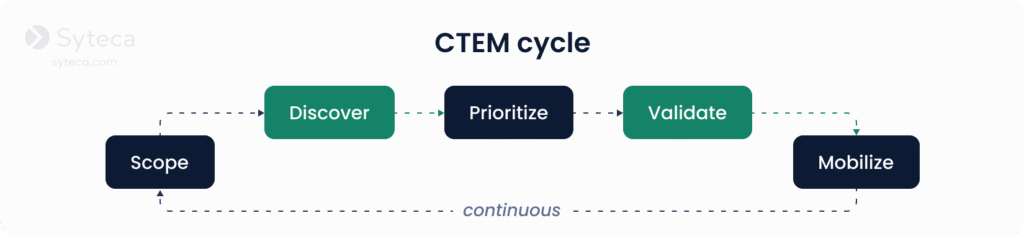
1. Scoping
Define the critical environments, assets, applications, and identities you need to protect. Scan across on-premises, cloud, and hybrid environments to find them.
An initial scope might cover one critical asset and its dependencies. This gives you a manageable area in which to complete the cycle before expanding coverage.
2. Discovery
Identify assets and security exposures within the established scope. Look beyond known common vulnerabilities and exposures (CVEs) to include shadow IT, insecure configurations, unmanaged cloud resources, SaaS permissions, and excessive privileges.
Combine findings from relevant security systems to identify security gaps. For each asset at risk, document who owns it, which users and systems can access it, and what permissions they are attributed to. This helps reveal what could be exposed and where an attacker could move next.
3. Prioritization
Rank exposures by real-world exploitability and business impact. Consider whether attackers can reach the affected asset, what access they would need, and what an attack could disrupt.
This stage reduces an overwhelming backlog of findings to the list of issues that pose the greatest risk and must be addressed first.
4. Validation
Test whether prioritized exposures create real attack paths in your environment and whether your existing controls can prevent or detect exploitation. Perform exposure validation procedures such as penetration testing, breach and attack simulation, or red teaming. Use the results to confirm or revise priorities before remediation.
5. Mobilization
Use validated priorities to guide your security team’s remediation work. Assign who’s responsible for what, and agree on deadlines and actions. Specify the remediation measures required for each type of exposure, such as applying patches, correcting misconfigurations, or restricting privileges.
CTEM vs. vulnerability management
CTEM and vulnerability management are related but not interchangeable. CTEM:
- Extends the concept of exposure beyond CVEs to include misconfigurations, identity gaps, credential leaks, and unvalidated attack paths.
- Operates as a continuous, business-aligned program instead of a periodic, tool-centric scanning process.
- Uses validation and mobilization to close the loop on real risk reduction rather then stopping at reporting and severity triage.
Traditional vulnerability management remains an important input to CTEM, especially for software flaws. CTEM elevates it into a wider exposure management approach that spans identities, endpoints, cloud, and third-party surfaces.
CTEM best practices
To make continuous threat exposure management effective, follow these steps:
- Start small and expand. Begin with one critical business service or a specific threat scenario. Once your security team can act on it with confidence, expand.
- Include identity and access risks. Track privileged accounts, service accounts, credentials, and permissions alongside software vulnerabilities, since they can be links in an attack path.
- Prioritize business consequences. Weigh exploitability, reachability, active threats, and the importance of affected services. Reassess priorities as those conditions change.
- Validate before assigning routine remediation. Give owners evidence that a finding is relevant and actionable. Validation should not delay urgent containment of an actively exploited exposure.
- Make ownership and follow-through explicit. Assign accountable teams and track verified closure, overdue high-impact findings, and recurring exposures. Revise accepted risks when their conditions change.
How to start a CTEM program
CTEM implementation guides recommend starting with a 90-day pilot cycle that scopes one critical attack surface, runs through discovery and prioritization, and completes at least one round of validation and mobilization. However, the terms can adapt as risks and business priorities change.
Compressing the five stages into three operational phases (scope, discover/prioritize, validate/mobilize) can also help your team demonstrate CTEM value with measurable exposure reduction before expanding to additional assets and environments.
As an inside security platform, Syteca can support your CTEM program. Syteca helps you secure privileged access, detect identity-based threats, reduce endpoint risk, and provide continuous session visibility through one unified platform.
Want to try Syteca? Request access
to the online demo!
See why clients from 70+ countries already use Syteca.
FAQ
CTEM is an ongoing security framework that brings together people, processes, and technology across five stages. Technology supports the program, but it cannot define business priorities, assign remediation owners, or verify risk reduction.
CTEM runs continuously, with different activities following risk-appropriate schedules. Keep discovery and prioritization up to date as environments change and threats evolve; schedule validation and ownership reviews accordingly. Significant changes, new exploitation evidence, or remediation should trigger immediate reassessment.