Generative AI tools like ChatGPT, Microsoft Copilot, and Gemini have already become everyday business tools. The latest McKinsey Global Survey on the state of AI reveals that 79% of organizations regularly use GenAI tools for one or more business functions. Check Point Research, meanwhile, reports that 87%–93% of organizations experience at least one high-risk GenAI interaction every month.
While GenAI platforms may significantly increase productivity, they also introduce new cybersecurity risks. This article discusses the main threats posed by GenAI tools and provides actionable tips on how to prevent data exfiltration and leakage via ChatGPT and other chatbots.
Key takeaways:
- GenAI tools like ChatGPT, Microsoft Copilot, and Gemini pose serious risks of data leaks, reputational damage, and compliance violations.
- ChatGPT data leaks mainly result from user error, account compromises, third-party breaches, platform vulnerabilities, or prompt injections.
- Source code, personal data, health data, financial records, legal documents, and credentials are among the highest-risk inputs.
- To reduce the risk of data exfiltration, organizations should define policies on acceptable GenAI use, enforce least privilege, implement continuous monitoring, and conduct user training.
- Syteca supports these security controls with privileged access management, session visibility, real-time alerts, threat response, and audit-ready evidence.
Is ChatGPT safe to use?
ChatGPT is safe for such tasks as drafting emails, brainstorming ideas, rewriting public information, or explaining concepts. However, it is not as safe for processing confidential company data, regulated personal information, or proprietary source code.
As for confidential information, organizations must assume that:
- Anything pasted into an unmanaged chatbot can leave your security perimeter and lead to a data leak via ChatGPT.
- Even if you disable training on prompts, your organization can still suffer from account compromise, third-party mistakes, and software vulnerabilities.
How ChatGPT handles data: Free/Plus vs. Business/Enterprise/API
| Service | Training | Key considerations |
| ChatGPT Free, Plus, and Pro | Training is enabled by default, but users can opt out. | Chats remain in history until deleted. Temporary chat is not used for training and is deleted within 30 days. |
| ChatGPT Business | Inputs and outputs are not used for training by default. | Workspace data is encrypted in transit and at rest. Users have private chat histories unless they choose to share a conversation. |
| ChatGPT Enterprise and Edu | Organization data is not used for training by default. | Managed identity, retention, access, and compliance controls are available for enterprise governance. |
| OpenAI API | Inputs and outputs are not used for training by default. | Retention varies by endpoint and configuration. Сustomers may optionally use zero data retention. |
Content sharing for model improvement is enabled by default for ChatGPT Free, Plus, and Pro users working in a personal workspace. These plans leverage extensive pre-training on diverse text data, fine-tuning with specific examples, and sophisticated algorithms to generate human-like responses based on the input it receives. In simple terms, your input may be used to influence the next request it receives from other users.
If you or your employees aren’t careful, information entered could put your company at risk. ChatGPT training data leaks even have their own name: conversational AI leak. However, conversational AI leaks are not the only threat posed by GenAI.
Main cyber threats posed by ChatGPT and other GenAI tools
A data leak via ChatGPT and other GenAI tools can also occur through:
Human error
Sensitive information isn’t only when typed manually into an AI tool. Employees may also unintentionally upload entire files to get a quicker answer, not realizing a file contains source code, customer records, contracts, incident reports, login credentials, spreadsheets, or system logs. Confidential data can also be exposed when employees share AI conversations through public links, screenshots, or copied responses that still include sensitive information.
Shadow AI
When employees install browser extensions or use unapproved third-party chatbots, they may create security gaps that your organization cannot see and control. Sensitive information can then be copied and stored by these tools without the security team knowing where the data went or how it was used.
External attacks
Attackers can gain access to employees’ AI accounts through phishing, reused or stolen passwords, information-stealing malware, or hijacked browser sessions. Once inside an account, they may be able to view saved conversations containing confidential business or personal information.
In one example, Group-IB reported that information-stealing malware had compromised more than 100,000 ChatGPT accounts, with stolen login credentials and conversation data offered for sale on dark web marketplaces.
Third‑party breaches
Companies may also be affected by security incidents involving third-party GenAI vendors. Even when conversations, prompts, and account credentials remain protected, GenAI vendors may expose user information such as names, email addresses, and account identifiers.
In November 2025, OpenAI disclosed an incident involving Mixpanel, a third-party analytics provider used for web analytics on its API platform. An attacker accessed Mixpanel’s systems and obtained a dataset containing limited account and analytics information.
An attacker breached analytics provider Mixpanel, exporting limited customer-identifiable data (names, emails, coarse location, OS/browser, referrers, IDs) from some OpenAI and ChatGPT help‑center users.
The incident did not expose ChatGPT conversations or credentials; however, the leaked profile and account metadata could still support targeted phishing, impersonation, and social engineering.
AI vendors rely on third‑party analytics; supply‑chain reviews and vendor security clauses are critical.
Platform vulnerabilities and prompt injection
Software flaws or carefully designed malicious instructions may cause a GenAI tool to ignore or bypass its normal security restrictions. The risk becomes greater when the tool can browse websites, run code, analyze uploaded files, or connect to company systems and applications. In these cases, an attacker may be able to use the AI to access or transmit information without the user realizing it.
In March 2026, Check Point Research demonstrated a hidden communication channel in ChatGPT’s code-execution and data-analysis environment. A single malicious prompt could use DNS requests to silently send parts of a conversation, information extracted from uploaded files, and other sensitive content to an attacker-controlled system.
A hidden outbound channel in ChatGPT’s code‑execution environment allowed data exfiltration via DNS using a single malicious prompt; OpenAI patched the issue in February 2026.
The vulnerability could allow attackers to silently extract user messages, uploaded documents, and sensitive insights generated from files without triggering a warning or consent request.
Prompt injection attacks can turn AI tools into covert exfiltration channels; organizations need runtime‑aware monitoring and strict input policies.
These cases do not mean that every session is exposed or that they can lead to a ChatGPT data breach. Nevertheless, they show why organizations should minimize the data users can access, restrict what they can submit, protect accounts and endpoints, monitor the use of GenAI tools, and preserve evidence for investigation.
What data is most at risk
The most exposed data types in ChatGPT‑related incidents include:
- Personally identifiable information (PII): Names, email addresses, billing addresses, and locations.
- Protected health information (PHI): Symptoms, medical history, lab results, and treatment details.
- Financial information: Payment metadata, billing addresses, card details, financial statements, and account numbers.
- Proprietary business information and source code: Trade secrets, internal algorithms, research, product designs, manufacturing processes, and internal documentation.
- Credentials and security information: Passwords, API keys, tokens, private keys, configuration files, vulnerability details, and incident logs.
- Legal and strategic information: Contracts, litigation material, merger plans, pricing, board documents, customer negotiations, and internal investigations.
This information should normally be prohibited or tightly controlled when employees use GenAI tools. Otherwise, organizations can suffer from negative consequences.
Negative consequences of data leakage via GenAI services
A data leak via ChatGPT and other chatbots can lead to numerous negative consequences, the most common of which are as follows:

- Loss of intellectual property. Leakage of proprietary information or trade secrets can result in a loss of competitive advantage, reduced market presence, and revenue loss. In addition, rivals may gain access to your valuable assets and use your technologies to their advantage.
- Operational disruption. Addressing and mitigating a data breach can significantly disrupt business operations, which undoubtedly leads to downtime and a decrease in overall productivity. Organizations might find it necessary to redirect significant resources toward investigation and remediation of the breach, as well as implementation of stronger security measures.
- Reputation damage. Customers and partners might lose trust in a company that suffers a data leak, which will definitely result in a damaged reputation. Additionally, negative publicity and media coverage can tarnish the brand’s image.
- Compliance violations. Failing to protect data adequately can lead to regulatory and legal consequences. Regulatory bodies are sure to impose sanctions or other legal actions against an organization for non-compliance with data protection laws and regulations, such as GDPR, HIPAA, PCI DSS, CCPA, FCRA, EU AI Act, and others. In addition, affected parties might file lawsuits against the organization for failing to protect their data adequately.
- Financial losses. Non-compliance with data protection regulations may result in significant fines and penalties for organizations. Also, organizations can face direct financial impact due to the loss of intellectual property, liability, fraud, theft, etc.
- Susceptibility to cyberattacks. Any data breach can make an organization a target for future cyberattacks, as bad actors may perceive it as vulnerable. Leaked data can be used for credential-stuffing attacks, which consequently result in unauthorized access to your systems. Cybercriminals can also use leaked data to craft more convincing phishing attacks on your employees.
These consequences show that GenAI-related data leakage is not only a privacy concern. It can affect an organization’s intellectual property, operations, regulatory compliance, finances, and overall security posture.
Reducing ChatGPT risk requires a layered approach that combines governance, employee awareness, access controls, technical safeguards, and continuous oversight.
The following best practices can help you harness the benefits of using GenAI chatbots while protecting your organization’s sensitive data from potential leaks.
Top 7 practices to prevent data leakage via GenAI tools
1
Create a robust policy for GenAI use
2
Define which types of data mustn’t be uploaded to GenAI services
3
Perform regular security awareness training
4
Enforce data security measures
5
Follow relevant cybersecurity guidelines
6
Limit access to sensitive data
7
Implement continuous monitoring
1. Create a robust policy for GenAI use
Define which GenAI tools, plans, accounts, integrations, and business use cases your organization approves.
The policy should clearly state:
- Which departments and roles may use GenAI tools, and under what conditions.
- Which data types must never be uploaded to GenAI services.
- When and how employees may use corporate GenAI accounts.
- When security, privacy, legal, or customer approval is required.
- Who reviews new GenAI tools and manages the presence of shadow IT.
- How employees should report a suspected data leak.
You should also lay out clear processes for how you’ll monitor adherence to your policies and decide on the consequences of possible violations. Establishing procedures for regular policy reviews and updates is crucial as well.
2. Define which types of data mustn’t be uploaded to GenAI services
Categorize data into sensitivity levels (public, internal, confidential, or restricted) and explicitly list what is forbidden in GenAI prompts.
For example:
- PII and PHI that are subject to GDPR, HIPAA, and similar regulations.
- Financial records and payment data.
- Proprietary code, manufacturing recipes, and trade secrets.
- Customer or employee databases.
- Credentials, secrets, tokens, or production logs.
Note that these are just some examples of critical info that mustn’t be revealed. Categorize data according to its sensitivity level (e.g. public, internal, confidential, restricted). Also, you may refer to laws like GDPR, HIPAA, or PCI DSS that define specific categories of sensitive data.
3. Perform regular security awareness training
Share the established policies with your employees and educate them on how to prevent data leaks when using ChatGPT. Provide guidelines on creating and maintaining secure accounts for the use of GenAI tools, emphasizing the importance of protecting accounts with 2FA and using corporate accounts rather than personal ones. If employees still must use personal service accounts for GenAI chatbots, educate them on securing these accounts with strong passwords and Single Sign-On (SSO).
Highlight that failure to adhere to these policies may result in disciplinary actions, including restricted access to AI tools, formal warnings, and, in severe cases, even termination or fines for NDA violations.
Talk about the tactics used by cybercriminals to trick people into providing sensitive information. Teach employees to recognize fake AI websites, malicious browser extensions, prompt injection, risky shared links, and unexpected requests to connect to corporate storage.
See Syteca in action!
Discover how Syteca can help you enhance your organization’s security.
4. Enforce data security measures
Enforce policies with security controls:
- Encrypt sensitive data at rest and in transit, and enforce strong authentication and authorization on systems that store regulated or high‑value data.
- Deploy SIEM and DLP solutions that can spot risky activity such as large copy‑paste events into browsers, uploads to known GenAI domains, or unusual outbound DNS traffic.
- Regularly audit third‑party vendors and analytics providers for security posture and incident‑response readiness.
Prepare an incident response plan specifically for GenAI‑related leaks so your security team knows how to revoke access, rotate credentials, and investigate chat histories when a data leak or breach is identified.
5. Follow relevant cybersecurity guidelines
Refer to the relevant cybersecurity frameworks governing AI use and provide guidelines on how to secure your systems while using AI tools. You may choose to stick to:
- The Blueprint for an AI Bill of Rights. This is a framework designed by the White House Office of Science and Technology Policy to guide the development and deployment of AI systems in a manner that protects the rights and freedoms of individuals. While it does not directly regulate AI use in the way that formal legislation or regulations do, it provides a set of principles aimed at ensuring AI technologies are used ethically and responsibly.
- AI Risk Management Framework (AI RMF) by NIST [PDF]. NIST has released a comprehensive framework to help organizations manage the risks associated with AI platforms. In July 2024, NIST also introduced AI RMF: Generative AI Profile [PDF] that can help organizations identify unique risks posed by GenAI specifically. Both frameworks aim to enhance transparency and accountability within organizations that utilize AI technologies, ensuring that AI tools are deployed responsibly.
- EU AI Act. The EU AI Act addresses risk management, data governance, technical documentation, recordkeeping, transparency, human oversight, accuracy, robustness, and cybersecurity. According to this act, high-risk AI systems must maintain an appropriate level of cybersecurity throughout their lifecycle. Providers of general-purpose AI models with systemic risk are subject to additional safety and security obligations. Organizations should therefore inventory their AI systems, determine whether they act as providers or deployers, classify relevant use cases, and identify which requirements apply to them.
Explore the power
of Syteca now!
6. Limit access to sensitive data
Safeguard your sensitive data, granting access only to necessary personnel. By minimizing access to your critical resources and continuously verifying access requests, you can significantly reduce the risk of a confidential data leak via ChatGPT or another GenAI platform.
For highly sensitive assets, use just-in-time access instead of standing permissions. Grant only the required access after verification, limit it to a defined timeframe, and revoke it automatically when the work ends. It’s also worth adopting the zero trust approach and the principle of least privilege to reduce the impact of accidental data disclosure and account compromise.
7. Implement continuous monitoring
Deploy a monitoring tool to get visibility into GenAI use and what data users input into it. Ideally, your monitoring tool should also be able to send automated alerts for any unusual activities to help you detect and respond to security incidents promptly.
Monitoring should also be transparent and privacy-aware. Use pseudonymization, sensitive-data masking, role-based access to records, and documented review procedures to maintain employee trust while preserving observability and evidence.
By following these best practices, organizations can leverage the benefits of GenAI services while minimizing the risk of ChatGPT data leaks and, consequently, intellectual property theft.
Syteca is a modern inside security platform that combines privileged access management (PAM) with native identity threat detection and response (ITDR), delivering privileged access control with deep session visibility, real-time incident response, and forensic-grade evidence. It helps organizations reduce the identity and user-activity risks that allow sensitive information to reach ChatGPT and other GenAI services.
Here are some of Syteca’s key features that can help you prevent ChatGPT data leakage:
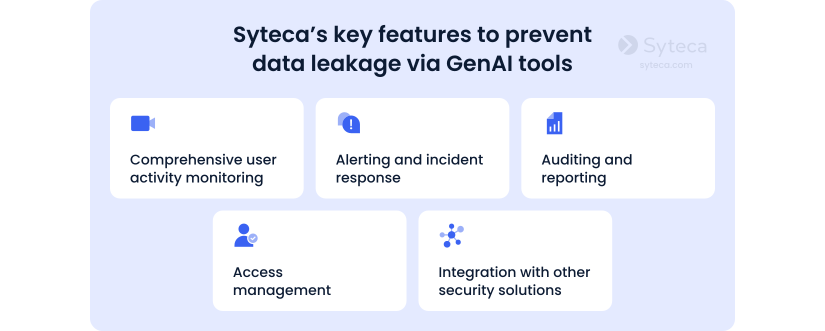
Comprehensive user activity monitoring
Syteca monitors and records user sessions across various endpoints, including desktops, servers, and virtual environments. This includes capturing all on-screen activity, which can help you view interactions with AI chatbots.
Along with on-screen activity, you can view searchable metadata:
- File upload operations
- Keystrokes
- Сlipboard activities
- Connected USB devices
- Launched applications
- Visited URLs
- Executed commands (Linux)
This evidence can help investigators determine whether a user opened an AI service, copied and pasted sensitive text, uploaded a file, or accessed restricted information.
Alerting and incident response
Security teams can configure URL alerts for chatgpt.com, chat.openai.com, platform.openai.com, and other GenAI domains that you specify.
Alerts can also be configured for specific keywords, file uploads, clipboard operations, application use, and other suspicious actions.
When an alert is triggered, you can:
- Watch live user sessions to monitor how employees use AI tools and what data they input into chatbots.
- Block the user or immediately terminate the application if their actions are malicious or harmful.
- Send a warning message to the user to let them know they’re violating your organization’s data handling guidelines.
This helps organizations respond when risky activity is in progress rather than discovering it after the damage is already done.
Auditing and reporting
Syteca provides searchable session records, contextual metadata, dashboards, and reports. Security teams can reconstruct an event timeline, identify the users and endpoints involved, review relevant on-screen activity, determine which data was accessed, and preserve evidence for auditors or incident responders.
Privacy-safe capabilities such as user pseudonymization and sensitive data masking can help maintain oversight without exposing unnecessary personal information.
Access management
Enforce strict access controls to ensure that users can only access your sensitive assets when needed to perform their job functions. This helps prevent employees from accessing information they don’t need and, therefore, from inputting it into a GenAI service.
Syteca PAM enables you to:
- Implement fine-grained access controls to specify who can access what endpoints and under what circumstances.
- Grant time-limited permissions to specific users upon request and revoke those permissions immediately after use.
- Restrict access to sensitive data based on the context, such as the user’s role or time of day.
- Automatically discover unmanaged privileged accounts across your infrastructure that could provide access to sensitive information.
- Secure privileged credentials in an encrypted password vault and control how users retrieve and use them.
The platform also lets you set two-factor authentication (2FA) for extra protection of corporate accounts.
Integration with other security solutions
Syteca seamlessly integrates with other types of security solutions to provide a comprehensive security ecosystem:
- SIEM. The platform can integrate with security information and event management (SIEM) systems to compile data from multiple sources and deliver a unified view of security events.
- Ticketing systems. Syteca can integrate with ticketing workflows, allowing organizations to validate access requests against approved tickets.
Together, these integrations support a visibility-first security model: control access → monitor activity → detect threats → respond in real time → preserve evidence.
Keep GenAI use visible and under control
The question is no longer whether employees will continue to use GenAI, but whether the organization can make that use visible, governed, and safe. The seven practices above can help you make the most of ChatGPT and other GenAI services without compromising your security.
Syteca can complement these practices by offering robust user activity monitoring, real-time alerting and response, and comprehensive access management capabilities.
Want to try Syteca? Request access
to the online demo!
See why clients from 70+ countries already use Syteca.
FAQ
ChatGPT data leakage can happen when users paste sensitive information into prompts or upload confidential files without disabling “training” mode. Data may also be exposed through vulnerable integrations, third-party incidents, software flaws, or prompt injection attacks.
People asking, “Will ChatGPT leak my data?” should know that private chats are not normally visible to other users. However, you may expose the conversation if you create a shared link, send a screenshot, use a malicious integration, or have your account or device compromised.
Whether ChatGPT is safe for company information depends on the selected plan, contractual protections, and retention settings. Organizations should approve both the tool and the specific use case before sensitive data is processed.
Yes, ChatGPT has experienced security incidents. In March 2023, a bug in the redis-py library exposed some users’ chat titles and limited billing details. This event is often described as the first ChatGPT data breach. In November 2025, a third-party Mixpanel incident exposed limited analytics data, but not prompts, conversations, passwords, API keys, or payment details.
Other users cannot normally browse your private ChatGPT history. However, someone may see a conversation if you share its link, publish a screenshot, or export it. For managed business workspaces, access and retention may also depend on the organization’s policies, administrative settings, and compliance requirements.
Other users cannot normally browse your private ChatGPT history. However, someone may see a In a personal ChatGPT workspace, go to Profile > Settings > Data Controls and turn off Improve the model for everyone. New conversations will then be excluded from model training. ChatGPT Business, Enterprise, Edu, and API data are not used for training by default unless the organization explicitly chooses to share them.
Disabling training addresses one aspect of ChatGPT privacy, but it still does not make personal accounts suitable for confidential company information.
To prevent a ChatGPT data leak, companies should provide approved corporate GenAI accounts, define which information employees must not upload, and conduct regular security training. Technical controls should include DLP, browser restrictions, MFA, least privilege, just-in-time access, and monitoring of file uploads and clipboard activity. These measures help prevent data leaks without forcing employees to rely on unapproved shadow AI tools.