In 2026, the most dangerous cyberattacks do not begin with malware or zero-day exploits. They begin with a login that looks legitimate. As identity becomes the new security perimeter, attackers no longer need to break in — they sign in. In this article, you will learn why this is the case, how legitimate access can be misused, and how ITDR solves the problem.
Key takeaways:
- Privileged access misuse is one of the most damaging cybersecurity risks in 2026, with identity-based attacks, credential abuse, and excessive privileges involved in a significant share of today’s breaches.
- The convergence of AI-driven social engineering, SaaS sprawl, and non-human identities has made privileged access easier to compromise and harder to detect.
- Traditional PAM is no longer sufficient, as it lacks visibility into what happens after access is granted.
- Combining PAM with identity threat detection and response (ITDR) capabilities enables visibility, threat detection, and real-time response, helping you detect privilege misuse early and limit potential damage.
Why privileged access misuse is a major concern in 2026
Privileged access refers to elevated permissions to systems, data, or configurations, such as those held by system administrators, service accounts, cloud admins, and third-party vendors.
When misused by malicious actors, privileged access allows them to bypass security controls, exfiltrate sensitive data, disable logging, and create additional accounts and backdoors.
Why are privileged accounts particularly dangerous when misused?
Primary value for cybercriminals
Since privileged accounts are used within the network and carry significant permissions, they are more effective at inflicting damage than external hacking.
Privileged accounts use an array of methods and permissions to access different parts of your IT infrastructure, providing attackers with numerous ways to strike.
Malicious activity under privileged accounts is difficult to detect, as it might look like the regular activity of privileged users.
Effortless evidence removal
With the higher level of administrative control they possess, privileged accounts can be used to delete logs or modify system settings to conceal any trace of malicious activity.
Privileged access misuse often involves using legitimate access in illegitimate ways, making it much harder to detect with traditional controls. As for threat actors, privileged access can be misused by malicious insiders, external attackers who gain control of privileged accounts, and negligent insiders whose mistakes sometimes result in security incidents.
But is the problem still worth paying attention to in 2026? It definitely is! Just look at the recent statistics:
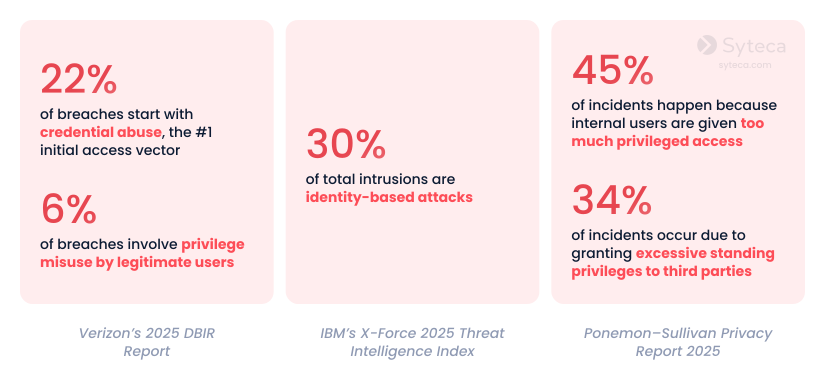
With identity as the new security perimeter, organizations must shift their focus from protecting IT infrastructure with traditional controls toward managing and protecting privileged identities. Let’s take a look at what makes 2026 different:
Why 2026 is different: Convergence of threats
Although attacks involving privileged access have always been a concern, several converging threats make privileged access especially dangerous in 2026:
Explosion of non-human identities
In some organizations, non-human identities like service accounts, API keys, AI agents, DevOps automation identities, and cloud workload identities outnumber human users. However, organizations do not put as much effort into protecting these identities as they do into securing human accounts. Often created with static credentials, high-level permissions, and no MFA, non-human identities can leave doors open for attackers to enter.
AI-driven attack acceleration
According to McKinsey’s 2025 research, phishing attacks and social engineering attacks are now fueled by generative AI. Gen AI helps malicious actors run hyper-personalized social engineering campaigns aimed at privilege escalation. An attacker armed with AI can now move from initial compromise to taking control of privileged accounts in hours rather than weeks.

SaaS sprawl and shadow admin paths
Some organizations use hundreds of SaaS applications, the majority of which are poorly governed. Each SaaS application has its own privilege model, contributing to a loss of centralized visibility and control. In addition, nested group memberships, role inheritance chains, and integrations create “shadow admin” paths that attackers can exploit.
Let’s explore why traditional defenses are no longer sufficient.
Identity as the new perimeter: Why traditional defenses are no longer sufficient
For many years, most organizations’ security strategies focused on defending the network perimeter: firewalls, intrusion prevention systems, VPNs, and network segmentation. The logic was simple: to keep attackers outside the network so systems remain safe inside.
This model is no longer effective, as cloud, remote work, and hybrid environments have eliminated traditional perimeters. Employees work from coffee shops; contractors access systems from foreign IP addresses; and data is stored in cloud platforms outside organizational control. There’s no clear delineation between inside and outsideanymore.
Today, identity is the new perimeter. The logic is as follows: an authenticated account serves as a gateway to systems and data, regardless of the method of login or who uses the account. An attacker doesn’t need to exploit vulnerabilities in system defenses, as simply compromising an identity grants “legitimate access”.
Such a shift fundamentally changes how security works. In addition to protecting the network, monitoring identity behavior and privileged access use is now crucial.
Standing privileges amplify potential damage, as they can give attackers access that isn’t time-limited. For example, a service account with permanent API credentials can create a backdoor that remains open for months. An insider with standing access to sensitive systems can exfiltrate data for an extended period of time without ever escalating privileges or establishing additional access. Instead, implementing a zero standing privileges policy drastically reduces the window of opportunity for privileged access misuse.
Now that we’ve explored the reason and the urgency for protecting privileged access, let’s examine the six most prevalent privileged access misuse scenarios organizations could face in 2026.
6 Common privileged access misuse scenarios
These access misuse scenarios represent both external attacks and internal misuse. Both are critical threats worth addressing.
1. Using compromised admin credentials
1. Obtain admin credentials
External attackers phish, steal, or otherwise compromise the credentials of a domain, cloud, or SaaS admin.
2. Authenticate as a trusted user
With only single-factor authentication still required in some privileged account security setups, the attackers can successfully log in without triggering MFA alerts.
3. Exploit the privileged access
Once authenticated, an attacker can use excessive standing privileges to change security policies, exfiltrate sensitive data, and cover their tracks.
Verizon’s 2025 Data Breach Investigations Report identifies credential abuse as the leading initial access vector, responsible for roughly 22% of breaches. Cybercriminals can acquire credentials via multiple channels, including targeted social engineering campaigns, keylogging malware, password vault compromise, and leaked credential databases purchased on the dark web. MFA fatigue attacks have also recently become a practical method to bypass weak or push-based MFA implementations.
2. Lateral movement and golden ticket attacks
After using a compromised user account to gain initial access, attackers gain elevated privileges by abusing role inheritance, nested group memberships, or delegation chains.
2. Impersonate high-privilege identities
In Active Directory environments, attackers steal or forge Kerberos authentication artefacts (or “golden tickets”) to impersonate privileged accounts without being detected in authentication logs.
3. Establish persistent privileged access
In cloud environments, attackers create additional privileged accounts and modify role assignments to ensure long-term access.
4. Move laterally across environments
With elevated privileges, attackers can move between systems, databases, and SaaS services, expanding control and minimizing detection with each compromise.
Lateral movement is particularly dangerous because each compromised system becomes a stepping stone to the next one. For example, an attacker might start by compromising a regular user account on a corporate computer and, step by step, escalate to a database admin role where they can access sensitive customer records.
The 2025 Ponemon-Sullivan Privacy Report highlights the scale of this issue, noting that 45% of incidents involve overprivileged internal users. Many of these privileged access paths are invisible to security teams, which can let attackers escalate privileges while avoiding detection.
3. Insider misuse of legitimate privileged access
1. Abuse trusted privileged access
A disgruntled employee, administrator, or subcontractor with access to your environment intentionally misuses legitimate privileged access to steal sensitive data, disrupt operations, or spy.
2. Operate within authorized boundaries
Since insiders already hold approved access, their actions may appear technically legitimate, allowing access-based security controls to be bypassed.
3. Conceal malicious intent
Insider threats usually progress slowly and deliberately, as attackers exfiltrate data in small volumes, access systems during off-hours, and hide malicious activity behind everyday duties.
Breaches caused by malicious insiders with privileged access cost organizations an average of $4.92 million, according to IBM’s 2025 Cost of a Data Breach Report. That’s why this access misuse scenario represents both a security and a financial risk.
Insider misuse is also difficult to detect because it doesn’t rely on stolen credentials. Instead, malicious insiders’ actions blend in with normal day-to-day activity, letting them use their knowledge of internal systems and monitoring gaps to minimize detection.
4. Privileged users’ inadvertent mistakes
1. Introduce misconfigurations
Overworked or poorly trained system administrators can unintentionally misconfigure systems, creating vulnerabilities.
2. Weaken access controls
For convenience or operational speed, some privileged users may try to bypass MFA controls, reuse credentials, or share passwords across teams.
3. Enable initial access through human error
Privileged users can fall victim to phishing, unintentionally opening doors for external attackers.
According to Verizon’s 2025 Data Breach Investigations Report, 60% of breaches involve some form of human element, including mistakes made by privileged users. While privileged users are not threats themselves in this scenario, their mistakes can let in external attackers. Inadvertent privilege misuse mostly occurs due to factors like understaffed teams, operational urgency, and security controls perceived as obstacles to productivity.
5. Exploiting compromised contractor or vendor accounts
1. Grant elevated third-party access
Organizations provide vendors, partners, or other third-party users with privileged access to support integrations, maintenance, or operational tasks.
2. Poorly secure and manage credentials
Third-party accounts are often weakly governed, lacking MFA, proper monitoring, and time-based access restrictions. This allows such credentials to persist beyond the point at which access is needed.
3. Compromise the vendor access path
Attackers breach a vendor’s environment or steal the credentials, inheriting trusted privileged access into the organization’s systems.
4. Expand impact across the supply chain
A single compromised vendor account can enable attackers to infiltrate multiple connected organizations.
The 2025 Ponemon-Sullivan Privacy Report highlights this issue, noting that 34% of incidents involve third parties with excessive privileged access. Third-party access extends your security risk beyond your organization’s own scope of responsibility. Vendors can operate with weak security standards, which makes them attractive targets for attackers.
Once a vendor is compromised, attackers can bypass your perimeter defenses by exploiting that vendor’s legitimate access to your systems. Sometimes a single breach can turn into a multi-organization incident or a supply chain attack, amplifying both operational and reputational damage.
6. Abuse of service and shadow accounts
1. Create overprivileged service identities
Service accounts used by applications, databases, and DevOps tools are provided with static credentials and excessive permissions.
2. Expose machine credentials
Credentials are hardcoded in application code, embedded in container images, or stored in unencrypted configuration files, creating vulnerabilities.
3. Expose trusted automated activity
Because of the large volumes of legitimate system activity service accounts generate, their compromise blends into normal operational noise.
4. Leverage shadow privileged accounts
Undocumented and unmanaged privileged accounts and shared admin credentials lie outside formal provisioning and deprovisioning processes.
Service and shadow accounts represent one of the least visible but dangerous privileged access risks. Unlike for human accounts, admins rarely rotate credentials for service identities or include them in access reviews. Cyber attackers target these accounts, as they provide persistent access that is difficult to distinguish from automated processes. Once compromised, service accounts function as stealthy backdoors that don’t trigger security alerts.
Having examined the six most common privilege misuse scenarios, an important question emerges: What’s there to do then?
How ITDR closes the security gap
Privileged access management (PAM) solutions are great for proactive control, protecting the “front entrance” and managing who can access what. However, PAM’s critical limitation is its inability to detect what authorized users do inside their sessions. Once an attacker gains PAM-managed credentials, or an insider with approved access turns malicious, their activity inside the session appears legitimate to PAM.
Identity threat detection and response (ITDR) is the missing layer that continuously monitors privileged user activity, detects potential threats, and responds if needed. ITDR excels at three critical functions PAM cannot provide:
ITDR’s core strengths

Identity activity context
Threat detection
Incident response
Identity activity context
ITDR allows you to thoroughly establish the context in which privileged identities behave after access is granted. By monitoring account activity in real time, ITDR can equip your security team with a clear understanding of who is acting, what they are doing, where, and under what conditions. This behavioral context helps distinguish legitimate activity from potential privilege compromise or misuse.
Threat detection
ITDR continuously analyzes identity-related activity to identify signs of malicious or abnormal behavior. By monitoring actions such as attempts to log in at unusual times, use of unauthorized USB devices, running suspicious apps, and other potentially risky activity, ITDR can detect threats that other access controls usually miss. ITDR detection is behavior-based and context-aware, enabling you to spot identity-related attacks before they escalate into broader security incidents.
Incident response
ITDR solutions allow for fast, targeted responses to identity-related threats through controlled or automated actions. When suspicious activity is detected, some ITDR solutions can enforce additional authentication, block identities, or terminate sessions. Tying incident response to identity and context, ITDR can help contain threats quickly and support effective investigation and recovery.
Critically, ITDR is not a replacement for PAM; rather, it is a complementary layer. Together, PAM and ITDR ensure full-cycle identity protection:
- PAM controls access — Who can log in, where, with what credentials, and under what conditions?
- ITDR tracks activity — What are various identities doing? Is their activity normal, or does it indicate privilege misuse?
Identity-first security: Detect privilege misuse early with Syteca
Having examined the threat scenarios, the limitations of traditional PAM, and how ITDR fills these gaps, we can now address the practical question: How can organizations actually implement an integrated PAM + ITDR approach?
Syteca is a modern PAM platform with built-in ITDR capabilities specifically designed to help you control, detect, and respond to privilege misuse.
Syteca includes the core features you expect from a comprehensive PAM solution. But unlike other tools that only include ITDR as an afterthought, Syteca was built from the beginning to incorporate ITDR capabilities, letting you continuously track user activity, record sessions, and collect evidence suitable for investigations. Deep visibility into what users do after access is granted allows your organization to spot suspicious behavior early and respond to threats in real time.
Here’s what the Syteca platform has to offer:
Syteca’s cybersecurity capabilities
Record privileged user sessions for accountability and forensic evidence
Session recording
Conclusion: From privileged access control to privileged threat detection
Whether compromised by external attackers or misused by insiders, privileged accounts can pose a serious risk to organizations. But in 2026, it’s clear that managing access alone is no longer enough, as traditional PAM solutions don’t answer the most important question: What happens after access is granted?
To successfully detect abnormal behavior and quickly contain incidents, organizations must shift away from assuming that privileged access is secure and treat misuse as inevitable. Syteca supports this shift by combining intelligent PAM with built-in ITDR, delivering continuous visibility into privileged identity activity and enabling you to mitigate threats before they cause damage.
Want to try Syteca?
Request access to the online demo!
See why clients from 70+ countries already use Syteca.