Zero standing privileges (ZSP) is a security model that removes persistent privileged access. The term was introduced by Gartner, which describes it as the desired end state of a modern just‑in‑time privileged access management (JIT PAM) strategy: no identity, whether human or machine, keeps privileged access when it’s not actively needed.
What are standing privileges?
Standing privileges are always‑on access rights assigned to specific accounts, regardless of whether elevated access is really needed at that moment. In practice, these are permanent permissions assigned for convenience, continuity, or emergency access.
They typically accumulate in:
- Administrator accounts that have broad access to servers, databases, endpoints, or cloud environments
- Service accounts used by applications, scripts, scheduled tasks, and automated processes
- Vendor and contractor accounts created for external support or maintenance
- Legacy, dormant, or orphaned accounts that were never properly reviewed or removed.
Standing privileges expand the attack surface and make identity-based attacks easier to execute. The main risks include:
Main risks of standing privileges
Privilege creep. Users and accounts collect more permissions over time as their roles, projects, and responsibilities change.
Privilege escalation. Attackers who compromise a regular account may exploit vulnerabilities to gain higher access.
Lateral movement. Once inside the environment, attackers can use privileged access to move across systems, reach sensitive assets, and increase the impact of a breach.
This is why you should focus not only on securing privileged credentials but also on reducing how long privileged access persists.
How zero standing privileges work
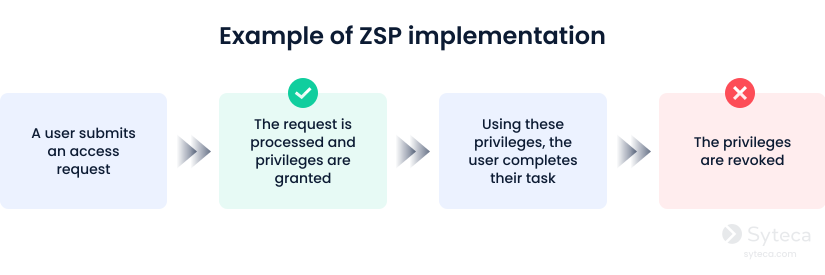
Zero standing privileges works by replacing permanent access with a controlled access lifecycle:
Request → verify → grant → auto-revoke
When a user needs privileged access, they submit a request. IT teams then verify the identity, context, and the business need. If they approve the request, privileged access is granted only for the required task and specific timeframe. After the session ends or the approved time expires, access is immediately revoked.
ZSP is built on four foundational principles:
- Zero privileges by default. No identity starts with privileged access rights.
- Just-in-time access. Privileges are granted only when needed and for a limited time.
- Just-enough access. Users receive only the minimum permissions required to complete their tasks.
- Automated revocation. Access expires automatically, reducing human error, e.g., due to reliance on manual cleanup.
ZSP also supports key principles of the zero trust approach since it assumes that no user, device, or session should be trusted by default.
Benefits of zero standing privileges
Implementing zero standing privileges delivers several security, compliance, and operational benefits. The key advantages include:
Main advantages of ZSP

Reduced attack surface
Lower risk of privilege misuse
Stronger zero trust alignment
Improved auditability
Stronger compliance readiness
Support for cyber insurance requirements
- Reduced attack surface. If users and accounts don’t keep permanent privileged access, stolen credentials become useless to attackers.
- Lower risk of privilege misuse. Temporary, scoped access limits what insiders, contractors, or compromised identities can do.
- Stronger zero trust alignment. ZSP supports continuous verification, the principle of least privilege, and context-aware access decisions.
- Improved auditability. Access requests, approvals, and revocation events can be logged for investigations and compliance audits.
- Better compliance readiness. Regulations such as SOX, HIPAA, PCI DSS, GDPR, NIS2, and DORA mandate strict access controls and JIT PAM, making ZSP a natural way to meet their critical requirements.
- Support for cyber insurance requirements. Insurers often evaluate privileged access controls, multi-factor authentication, access reviews, and incident response readiness when assessing cyber risk.
How to implement zero standing privileges
Moving to zero standing privileges requires a structured approach that balances security, operational continuity, and user productivity.
Start with these steps:
Key steps for implementing ZSP
1
Discover all standing privileges
3
Enforce least privilege
4
Automate credential governance
5
Monitor privileged sessions
1. Discover all standing privileges. Identify all unmanaged privileged accounts across your environment. Then, make sure to bring them all under control.
2. Apply JIT access. Replace always-on access with manual requests, ticket-based approvals, additional verification, time-bound access, and automatic revocation.
3. Enforce least privilege. Limit privileges by role, task, system, session, and business context.
4. Automate credential governance. Vault, rotate, and validate privileged credentials to prevent password drift and reduce exposure.
5. Monitor privileged sessions. Record and analyze events after access is granted to detect misuse, stop incidents, support investigations, and prove compliance.
Syteca is a comprehensive cybersecurity platform that supports privileged account discovery, just-in-time access, credential governance, and session monitoring, helping organizations move toward zero standing privileges while maintaining visibility into what happens after access is granted.
Want to try Syteca? Request access
to the online demo!
See why clients from 70+ countries already use Syteca.
FAQ
Just-in-time access is a way of granting temporary privileged access only when needed. Zero standing privileges is the permanent state where all persistent privileged access is eliminated. In other words, JIT access is one of the key mechanisms that help organizations achieve ZSP.
Zero trust is based on the idea that no identity or device should be trusted automatically. ZSP supports this approach by removing default privileged access, verifying every access request, limiting permissions to the minimum required scope, and revoking access immediately after use. This reduces the chance that compromised credentials or excessive permissions lead to a serious security incident.