The security risks begin when AI stops recommending and starts acting. An AI agent that can access a database, change a configuration, create an account, transfer data, or trigger a business process is no longer safe without proper governance. From a security perspective, it is a powerful identity operating inside the enterprise.
That makes privileged access management and activity monitoring central to agentic AI security. In this article, we examine why AI agents should be treated as privileged identities, the risks they create, and the measures your organization needs to keep them under control.
Key takeaways:
- Organizations need to treat AI agents as privileged identities as they may hold broad permissions, operate continuously, and make decisions without direct human approval.
- Controlling access is only one part of the problem. You must also capture, analyze, and investigate what happens after access is granted to an AI agent.
- Strong agentic AI security combines identity controls, privilege management, context collection, activity monitoring, and rapid response.
- Syteca can support these controls by providing visibility into agentic AI activity and by complementing other AI-specific security measures.
Why agentic AI creates a different security challenge
Agentic AI introduces security risks that are fundamentally different from those driven by traditional software and generative AI tools. Agentic AI security risks are becoming increasingly urgent, with 79% of respondents to PwC’s AI Agent Survey saying that their companies are already adopting AI agents.
Unlike conventional AI tools that only analyze information or generate responses, AI agents can interact with systems, use applications, access data, and complete tasks with little to no human involvement.
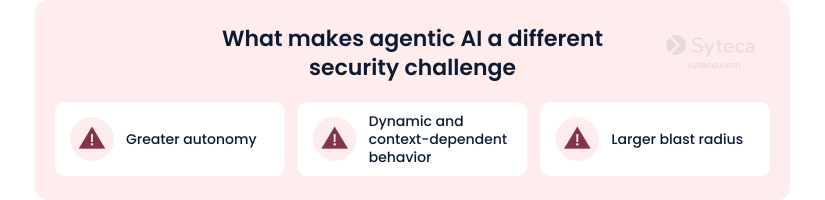
Greater autonomy
Unlike generative AI tools, AI agents can plan a sequence of steps, select tools, make decisions, and take actions across connected systems to achieve a broader objective.
Depending on its permissions and autonomy settings, an AI agent may access a database, modify a configuration, create an account, or initiate a workflow without direct supervision at every stage. This autonomy can improve efficiency, but it also reduces the number of points at which an admin reviews or approves an action, potentially leading to poor or unsafe agent’s decisions
Dynamic and context-dependent behavior
Like traditional software, gen AI tools are designed around predefined workflows and explicit conditions. AI agents are created to adapt. They interpret broad instructions and determine their next steps based on the context available at that moment.
This flexibility is one of their main advantages, but it also makes AI’s actions harder to anticipate. An agent may respond differently when it receives incomplete data, conflicting instructions, unexpected system feedback, or maliciously manipulated content. Therefore, security teams cannot assume that approving an agent’s initial request guarantees that every subsequent action will remain appropriate and safe.
Larger blast radius
A generative AI error may result in an inaccurate or misleading answer. While an agentic AI error can have direct operational consequences.
Depending on its permissions, an AI agent may transfer sensitive data, change system configurations, create or modify accounts, initiate transactions, or disrupt services. Because agents can perform multiple connected actions in a short period, a single mistake or compromised instruction may lead to agentic AI security threats and affect multiple systems.
Why you should treat AI agents as privileged identities
AI agents increasingly require access to business applications, sensitive data, cloud services, administrative tools, and other critical resources. To perform tasks independently, they require credentials, permissions, tokens, or service accounts that allow them to act across multiple systems.
From a security perspective, they function as privileged identities, and you should govern them with controls similar to those you apply to your administrators, vendors, service accounts, and other high-risk identities.
Here are the reasons why:
AI agents need privileged access governance because they:
- operate through non-human identities
- may act on behalf of another identity
- pose risks similar to those of privileged users
AI agents operate through non-human identities
AI agents mostly access systems through non-human identities, such as service accounts, application accounts, API keys, machine identities, or access tokens. According to the Cloud Security Alliance, 52% of organizations use workload identities for AI agents, while 43% rely on shared service accounts.
These identities may have broad permissions because the agent needs to perform steps across different systems. AI agents may also operate continuously, even during off-hours, making it harder to detect anomalous or malicious actions based solely on time.
Without proper service account discovery and AI identity governance, you may not know which identities belong to AI agents, what resources they can access, or whether their permissions remain appropriate.
AI agents may act on behalf of another identity
An AI agent may also perform actions on behalf of an employee, administrator, or another system. Cloud Security Alliance Study found that 31% of organizations allow agents to operate under human identities. This creates a delegated identity relationship. As a result, knowing which account accessed a resource is no longer enough. In fact, 68% of organizations say they can’t clearly distinguish human activity from AI-agent activity, as the same study reveals.
For security purposes, you must understand who or what instructed the agent, who or what authorized the action, and whether the agent acted within the approved scope. Without this context, it may be difficult to determine accountability or reconstruct the chain of events during an investigation.
AI agents pose risks similar to those of privileged users
Privileged identities pose high risks because they can affect critical systems and sensitive data. AI agents with similar permissions create a comparable risk profile. 74% of organizations report that AI agents have more permissions than they need. And with broad access, agentic AI risks become more serious.
Overprivileged agents can make incorrect decisions, expose credentials, or be manipulated into performing unauthorized actions. Attackers may also target agent identities because compromising a single account could grant access to multiple connected resources.
The main privileged access risks created by AI agents
Many of the agentic AI risks resemble those of privileged access management, but AI agents intensify them due to speed, scale, and automated decision-making. The following risks require particular attention:
Agents may receive access to more systems, data, and functions than their tasks require. Broad permissions simplify deployment, but they also increase the consequences of mistakes, compromise, and unauthorized behavior.
Standing privileged access
Privileged permissions may remain continuously available instead of being granted only for a specific task or time period. This allows an agent to use elevated access whenever it is triggered, including after receiving malicious or incorrect instructions.
Permissions can also expand each time an agent is assigned a new integration or responsibility. Without regular review, outdated rights remain in place and create unintended combinations of access.
Shared accounts and credentials
Several agents may operate through the same service account or credential. This obscures attribution, weakens accountability, and makes it difficult to revoke one agent’s access without affecting other identities.
Agents may encounter secrets in prompts, files, code, logs, or tool responses. They may accidentally disclose those credentials or be manipulated into revealing them, allowing attackers to access systems independently of the agent.
An agent may pass tasks to other agents, services, or tools without preserving the limits of the original authorization. As a result, delegated actions may exceed the scope approved by the initiating user or process.
Orphaned agents and credentials
When an agent is no longer in use, its associated accounts, tokens, and secrets may remain active. These forgotten access paths can persist without a clear owner or legitimate business purpose.
Privilege misuse caused by manipulated inputs
Prompt injection, malicious documents, compromised data, or deceptive tool responses may cause an agent to use valid privileges in unsafe ways. The action may be technically authorized while still violating security policies or business intent.
These risks show why granting proper access is only the beginning of agentic AI security.
Identity and access controls alone are not enough
Identity and access controls are essential to AI agent security. However, these controls alone aren’t sufficient.
You must also control how privileges change over time, how they are delegated, and how they are used in practice.
The role of privileged access control for agentic AI security
Privileged access management can help you answer important questions before and at the moment an AI agent receives access:
- Which agent is requesting access?
- How is it authenticated?
- Which credential or role is it using?
- Which resources may it access?
- How long should access remain active?
- How is the approval granted?
PAM process helps establish that access is legitimate, appropriately limited, and linked to a recognized identity or workflow.
Yet authorization does not guarantee that every action taken during the session will be safe or appropriate. An agent may access the correct resource with valid credentials and approved permissions, but still perform an unauthorized action, follow a manipulated instruction, transfer the wrong data, or make a change that conflicts with business needs.
Therefore, you should have a clear visibility into what happens after access is granted: the agent’s actual activity, including which commands it runs, which records it views or changes, which files it transfers, and how its behavior relates to the task it was authorized to complete.
Why AI agent security needs activity monitoring
Identity controls govern entry. Activity monitoring and accountability controls govern what happens next.
With a combination of identity controls and activity monitoring, you can observe agent behavior, link it to the decisions and identities behind it, and preserve evidence of what occurred.
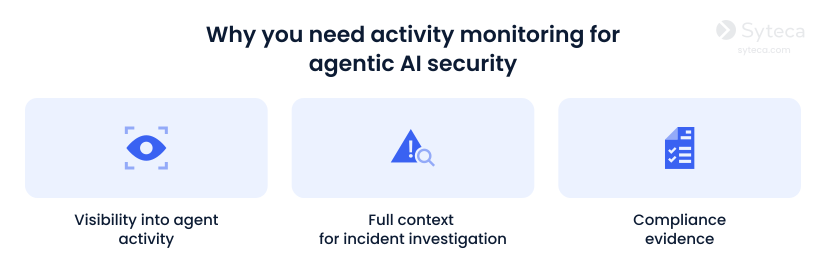
Visibility into agent activity
Your security team needs visibility across the agent’s full set of tasks, not just the initial authentication event or individual API calls.
An agent may access multiple systems, retrieve data, invoke tools, modify records, and trigger downstream actions as part of a single workflow. Monitoring these activities in sequence helps security teams determine whether the agent remained within its intended scope.
Relevant visibility may include the applications and systems accessed, commands executed, files transferred, records viewed or changed, and other actions taken with elevated permissions.
Full context for incident investigation
Basic technical logs may show that an account executed a command or accessed a resource, but they often provide little explanation of why the action occurred. To properly assess agent behavior, your security team needs to connect technical activity with its wider context, including the agent involved, the initiating user or process, the assigned task, the instructions and inputs it received, the permissions and credentials used, the systems affected, and a clear sequence of actions.
This context is also essential when an AI-driven incident occurs. It allows your security team to reconstruct events from beginning to end, distinguish legitimate automation from malicious activity, and establish the incident’s timeline and impact. Detailed activity records also help identify which controls failed and what needs to be changed.
Compliance evidence
AI-agent accountability should be integrated into your existing governance and compliance processes.
You need to be able to demonstrate who authorizes an agent’s access, what privileges it receives, and how those privileges are used. This evidence can support certifications, internal audits, and regulatory inquiries.
Incorporating agent activity monitoring into access reviews, audit preparation, and compliance reporting helps organizations prove that AI-driven actions are subject to meaningful oversight.
How to secure agentic AI: 8 key controls to implement
Securing agentic AI requires more than restricting access and authentication. Your organization needs controls throughout the AI agent lifecycle, including agentic AI security best practices such as AI agent discovery, privilege management, activity monitoring, behavioral analysis, and incident response.
Key steps to establish robust agentic AI security
Discover and inventory agents
Assign unique identities to agents
Implement authentication and credential controls
Establish privilege elevation and approval workflows
Ensure quick response to incidents
1. Discover and inventory agents
Establishing full visibility over your AI ecosystem is critical for eliminating security blind spots and ensuring compliance. Start by identifying every AI agent operating across your environment, including approved software, experimental tools, embedded assistants, and agents introduced by third-party applications. Document where each agent runs, which systems it connects to, and what business function it performs.
Maintain a centralized inventory that links every agent to an owner, technical identity, credentials, permissions, tools, and connected resources. Update this inventory as agents are created, modified, or retired so that unmanaged agents and forgotten access paths do not remain hidden.
2. Assign unique identities to agents
Give each AI agent its own distinct identity rather than allowing multiple agents to share a service account, API key, or a generic technical user. A unique identity enables access controls to be applied to each agent individually.
It also improves accountability by allowing security teams to attribute actions, review permissions, detect unusual behavior, and revoke access without disrupting other agents or workflows.
3. Define ownership
Assign every AI agent both a business owner and a technical owner. The business owner is accountable for the agent’s purpose and intended use, while the technical owner oversees its configuration, integrations, access, and security controls.
Defining ownership ensures that someone is responsible for reviewing the agent as its role changes, approving access, addressing security issues, and confirming when it should be modified or deleted. Without defined owners, agents can remain active long after they are no longer needed.
4. Implement authentication and credential controls
Verify every AI agent’s identity before allowing it to access enterprise systems, applications, or data. Use strong authentication methods appropriate for non-human identities, and avoid relying on weak, static, or broadly shared credentials.
Store secrets, tokens, certificates, and API keys in secure credential management systems rather than embedding them in code, prompts, or configuration files. Rotate credentials regularly, limit their scope and lifetime, and revoke them immediately when an agent is no longer in use or its security is compromised.
5. Establish privilege elevation and approval workflows
Grant elevated access to AI agents only when a specific task requires it. Keep agents operating with standard permissions by default, then allow them to request additional privileges for a limited purpose and time.
Require approval for high-risk actions and record who authorized the elevation, which permissions were granted, and when they expired. This reduces the risks created by standing privileged access and makes exceptional access easier to review.
6. Monitor agent activity
Capture what each AI agent does after access is granted, including the commands it executes, files it transfers, and changes it makes. Monitoring should cover the implementation of the task rather than isolated authentication or access events.
Link this activity to the specific agent, its assigned task, the permissions it uses, and the user or process that initiated the action. This context helps security teams determine whether the agent uses its access as intended.
7. Analyze agent behavior
Compare each AI agent’s current activity with its established baseline, approved purpose, and expected task. Behavioral analysis can reveal unusual activity patterns, such as unexpected tool use, abnormal data transfers, or any other actions that fall outside the agent’s normal workflow.
Treat deviations as signals for further review. Reviewing those cases can help you identify errors, manipulation, compromise, or misuse of an AI agent.
8. Ensure quick response to incidents
Set up real-time alerts for high-risk or unexpected agent activity. Alerts should immediately notify security teams of potential violations so they can investigate and respond before the incident occurs.
Use automated response actions to contain incidents. Depending on the severity, this may include pausing the agent’s identity or terminating its session, revoking credentials, restricting access, or requiring human approval before it can continue.
Add visibility to agentic AI security with Syteca
Agentic AI security requires a coordinated set of controls across the full lifecycle of AI agents. Syteca addresses a critical area that most vendors overlook – visibility into AI agents’ activity.
Syteca is a cybersecurity platform combining privileged access management (PAM) with identity threat detection and response (ITDR) capabilities to close the gap between controlling access and understanding what happens after it is granted.
Syteca helps you discover privileged accounts, including those used by AI agents, authenticate identities, secure credentials, establish an access approval workflow, and provide just-in-time access to critical resources. ITDR capabilities allow you to monitor and record activity, detect suspicious behavior in real time, generate alerts, and automate response actions.
By combining access controls with ITDR, Syteca can help you address relevant security and data privacy requirements under NIS2, DORA, the GDPR, and other laws and regulations. This unified approach supports stronger oversight of privileged identities, including AI agents that interact with your critical resources.
Want to try Syteca?
Request access to the online demo!
See why clients from 70+ countries already use Syteca.
FAQ
Agentic AI security is the practice of protecting AI agents, the identities and credentials they use, and the systems and data they can access. It combines AI-specific safeguards with identity governance, privileged access controls, activity monitoring, behavioral analysis, and incident response.
AI agents can operate continuously, execute actions at machine speed, interact with multiple systems in a single workflow, and make decisions without human approval at every step. Securing them, therefore, requires not only authentication and access management but also strong controls for non-human identities, credentials, delegated access, post-access monitoring, and behavioral analysis.
A non-human identity is a digital identity used by a machine, application, service, workload, or AI agent rather than a person. Examples include service accounts, workload identities, API credentials, certificates, and tokens. Like human identities, they need appropriate authentication, permission control, ownership, lifecycle management, and monitoring.
Consider implementing dedicated activity monitoring tools. Monitor the agent’s activity throughout its workflow, including the systems and resources it accesses, the commands it executes, the files it transfers, and the changes it makes. Connect these records to the agent’s identity, permissions, assigned task, and initiating user or process so security teams can detect unusual behavior, investigate incidents, and verify that privileges are used as intended.
There is no single compliance framework that covers every aspect of agentic AI security. Depending on the organization, location, and industry, relevant requirements may come from cybersecurity and operational-resilience regulations such as NIS2 and DORA, data protection laws such as the GDPR, and AI governance frameworks and standards such as the NIST AI Risk Management Framework and ISO/IEC 42001.
These frameworks address different aspects, including cybersecurity risk management, access control, monitoring, incident response, accountability, AI governance, and data protection.