

Configure rotation
1
Open the secret
Sign in to the Management Tool, click Password Management, and click the required secret to edit it.
2
Go to the Automation tab
In the Edit Secret window, select the Automation tab.
3
Enable and schedule rotation
Select Enable remote password rotation and set the frequency in Rotate Password Every. To rotate immediately, click Rotate Now.
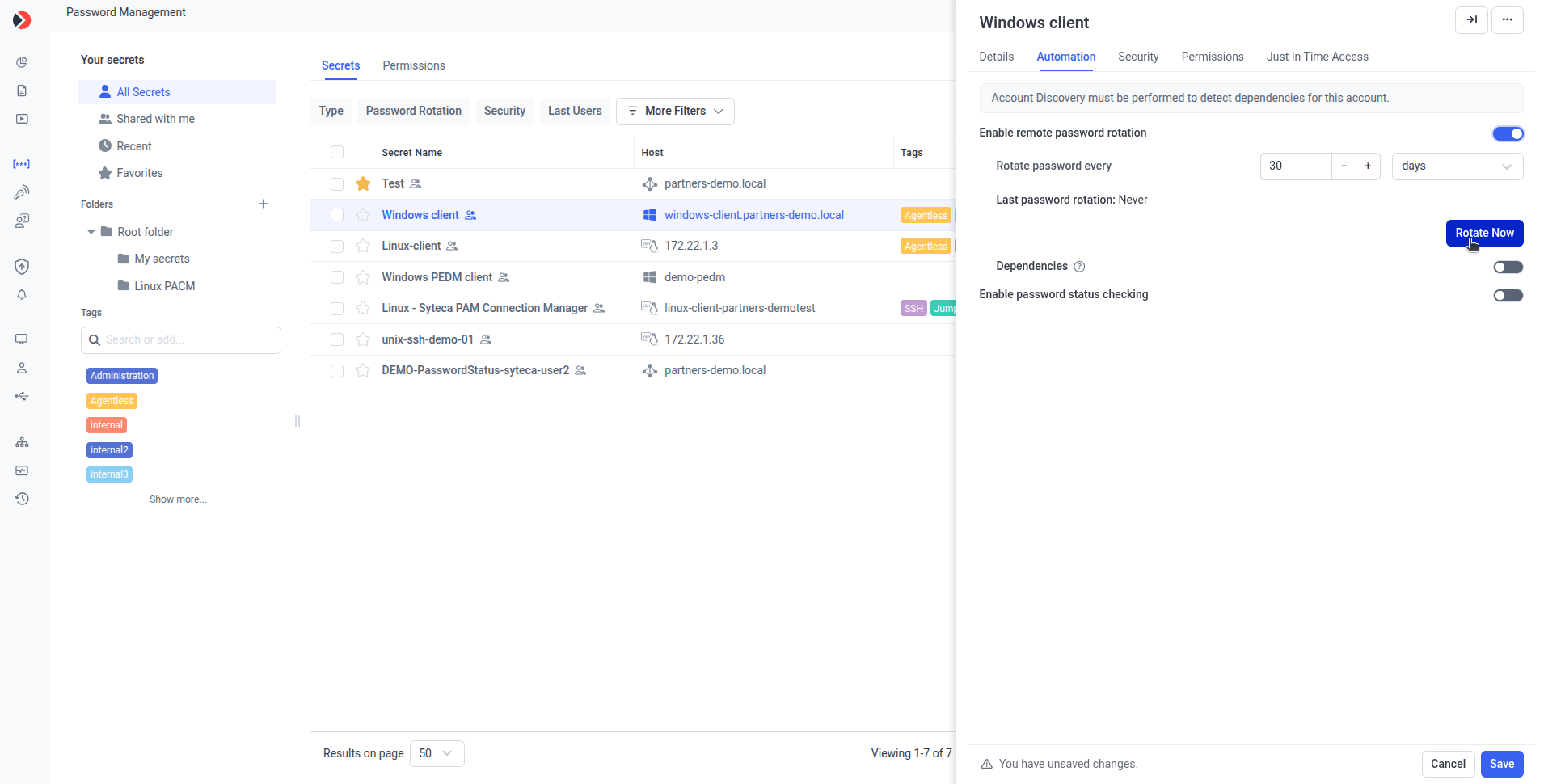
Enabling remote password rotation on the Automation tab.
Password complexity policy (optional)
You can change the minimum complexity of generated passwords by adding any of these keys to theEkranServer.Settings.config file and setting the value (defaults shown):
EkranServer.Settings.config
The source describes the
Digits, Upper, and Lower keys with overlapping labels (the descriptions and the key names don’t line up cleanly). The key names and min/max values above are reproduced exactly from the source; confirm which key maps to which character class during review before publishing.EkranServer.Settings.config is in C:\Program Files\Ekran System\Ekran System\Server on the Application Server host. Confirm whether this path has changed under the Syteca brand.Preconditions for Windows account secrets
These must be met on the remote computer where the Windows account is located.1. Disable Remote UAC (Windows 10 and 11 desktop OSs)
1. Disable Remote UAC (Windows 10 and 11 desktop OSs)
- Open the Windows Registry Editor.
- Select
HKEY_LOCAL_MACHINE\SOFTWARE\Microsoft\Windows\CurrentVersion\Policies\System. - If
LocalAccountTokenFilterPolicydoes not exist, choose Edit > New > DWORD (32-bit) Value and add — Value name:LocalAccountTokenFilterPolicy, Value data:1. - If it already exists, right-click it, choose Modify, set Value data to
1, and click OK. - Restart the computer.
2. Keep the Remote Registry service running
2. Keep the Remote Registry service running
The Remote Registry service must be running (including on Windows 10 and 11 desktop OSs). On some OSs it can stop automatically after a while (for example, after 10 minutes), which causes rotation to fail. To prevent it from idling out, set:
- Key:
HKEY_LOCAL_MACHINE\SOFTWARE\Microsoft\Windows NT\CurrentVersion\RemoteRegistry - Name:
DisableIdleStop - Type/data:
REG_DWORD,1
3. Disable account lockout
3. Disable account lockout
- Press Win+R, enter
secpol.msc, press Enter. - Select Security Settings.
- Open Account Policies > Account Lockout Policy.
- Double-click Account lockout threshold.
- Set Account will lock out after to
0(disabled), then Apply and OK.
4. Set the account password to never expire
4. Set the account password to never expire
- Press Win+R, enter
lusrmgr.msc, press Enter. - Under Local Users and Groups (Local), select Users.
- Right-click the user, choose Properties.
- On the General tab, select Password never expires, then OK.
5. Enable the required firewall rules
5. Enable the required firewall rules
- Remote Service Management (NP-In)
- Remote Service Management (RPC)
6. Set Minimum password age to 0 days
6. Set Minimum password age to 0 days
- In Local Security Policy, open Security Settings > Account Policies > Password Policy.
- Set Minimum password age to
0days.
The Application Server host must be able to resolve target computer hostnames during account onboarding (see Account Discovery). If a Windows local account is onboarded by hostname, the Application Server must resolve that hostname — important when the target is in a different domain. One option is to configure a domain suffix search list on the Application Server host that includes all network domains (Microsoft guidance). Alternatively, use FQDNs or IP addresses during onboarding.
Preconditions for Unix account (SSH) secrets
For Unix account (SSH) secrets, PuTTY must be installed on the Connection Manager computer. You can select Use SSH key instead of Use password when adding the secret. The examples below assume the target host runs an OpenSSH server (the common case on Linux).
SSH password rotation
Precondition: the Login and Password in the secret must be valid for the target host. How it works: the Application Server connects with the secret’s credentials and changes the current user’s password to a newly generated one. Both old and new passwords are stored in the database during the operation; the old one is deleted only after everything succeeds. On failure, the password is restored to a valid state from one of the two.SSH key rotation
Precondition: the Login, Private Key, and Private Key Passphrase in the secret must be valid for the target host, and the matching public key must be in~/.ssh/authorized_keys in the user’s home directory. PuTTY can be used as the SSH client; the key in the secret must be in PuTTY format (PuTTYgen guidance).
How it works: the Application Server connects with the Login and Private Key and replaces the public key in ~/.ssh/authorized_keys with the new one matching the newly generated PuTTY key. Both old and new keys (and passphrases) are stored during the operation; the old key is deleted only after success. On failure, the key is restored from one of the two.
Establish the SSH connection
This sub-section is not available in SaaS.
1
Confirm the target is online
Make sure the target computer is reachable.
2
Confirm OpenSSH server is running
3
Allow SSH through the firewall
Debian/Ubuntu:CentOS/RHEL:
4
Allow the default SSH port
Debian/Ubuntu:CentOS/RHEL:
5
Validate the sshd config
6
Test the connection from the Application Server host
Open a command prompt (Win+R, Add the host to known hosts if prompted (this does not affect scanning or onboarding). A successful connection confirms SSH works.
cmd) and run:7
Confirm Bash is installed for the user
Related
Add a secret
Enable rotation while creating a secret.
Password checkout
Optionally rotate on every check-in.
File transfer
Requires the password to be rotated at least once.
Account Discovery
Discover and onboard accounts to manage.