

Find the page at Configuration → Serial Key Management → Automatic License Assignment. The Serial Key Management tab is now an expandable section with three sub-items: Serial Key, Tenant Licenses, and Automatic License Assignment.
How a license gets assigned
When an endpoint needs a license, the Application Server resolves it in this order:
Only position in the table decides priority. A rule matching a single IP address has no precedence over a rule matching an endpoint group simply because it is more specific, so put narrow rules above broad ones.
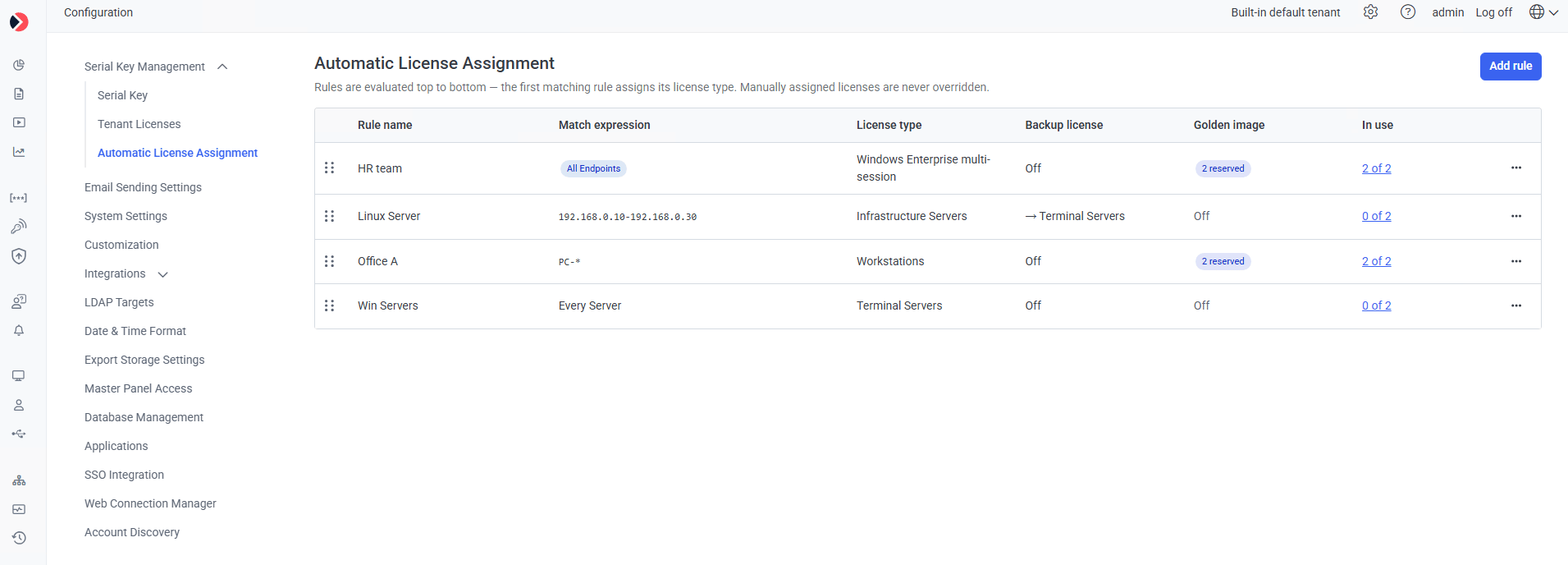
Rules are evaluated top to bottom, with the Default rules usually sitting last.
The rules table
A few things about these values that are easy to misread:
- In use counts licenses reserved by any Golden image rule as used, and is not affected by the rule’s backup license. Clicking it opens the Endpoints section filtered to that license type.
- In use refreshes when the page loads or updates, not continuously while you watch it.
- Default for Servers and Default for Workstations are ordinary rules. They can be reordered, edited, duplicated, and deleted like any other, and they carry no special styling.
- Duplicate rule places the copy directly below the original and adds “(copy)” to the name. The Golden image toggle and its reservation are not copied, so the duplicate starts with Golden image off.
Create a rule
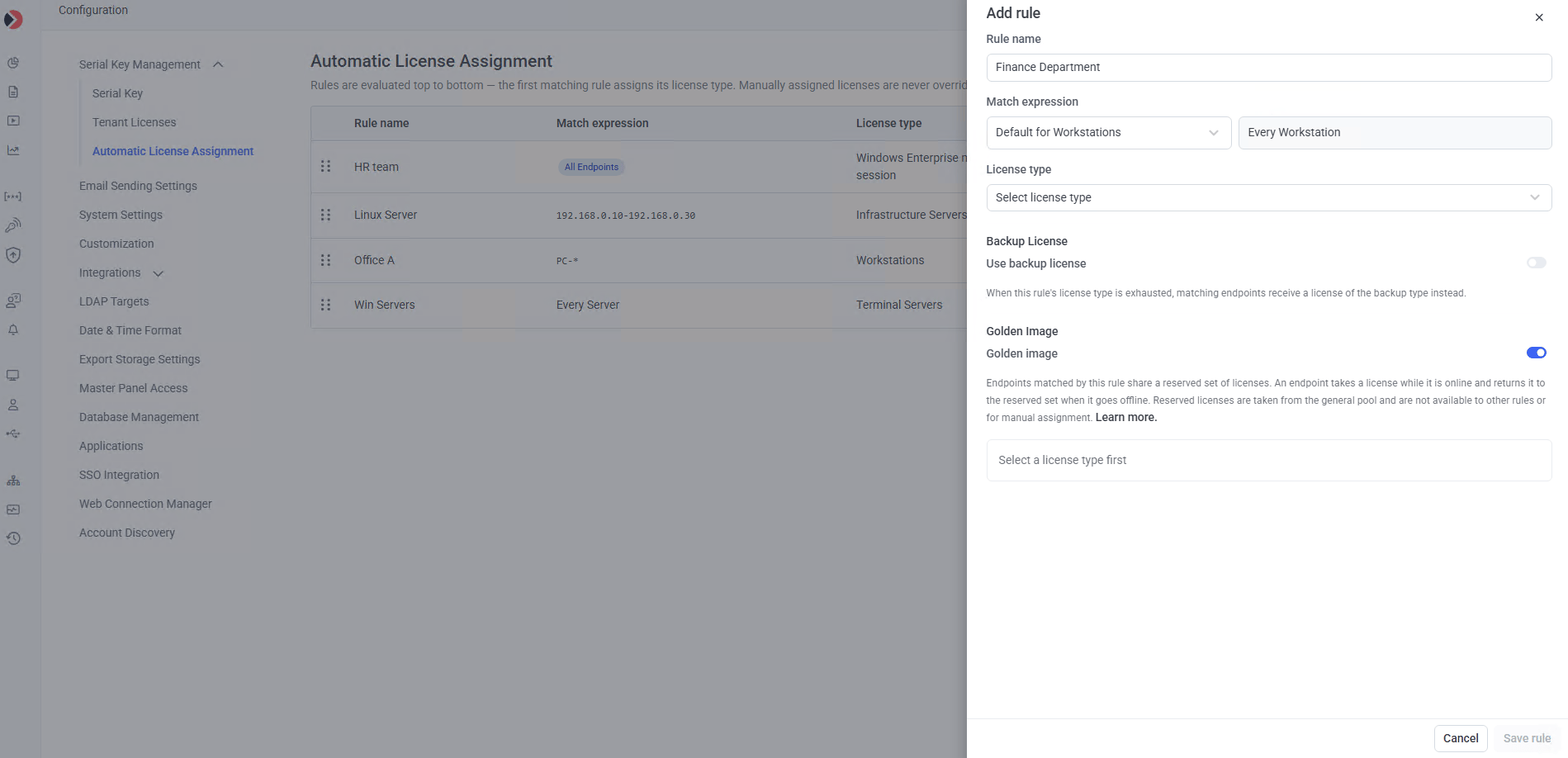
The rule form, with Golden image switched off.
1
Click Add rule
The rule form opens. Rule name and License type are always required.
2
Name the rule
Use a name that says which machines it covers, because the name is what appears in the audit log and in System Health records when something goes wrong.
3
Choose a match expression
Pick an expression type, then fill in the dependent input:
Only one Default for Servers rule and one Default for Workstations rule can exist per tenant. Once one exists, that option disappears from the list.
4
Choose the license type
The list contains every endpoint license type in the activated serial key. Custom license types appear under the unique name defined for them.
5
Decide what happens when the license type runs out
Turn on Use backup license and pick a second license type to fall back to. The list excludes the rule’s own license type, since a rule cannot back itself up.With the toggle off, an endpoint that matches the rule stays unlicensed when the license type is exhausted.
6
Decide whether endpoints share a reserved pool
Leave Golden image off for permanent assignment. Turn it on for VDI and other non-persistent endpoints, and enter how many licenses to reserve. See Golden image rules.
7
Save the rule
Click Save rule. The rule is added to the table, and any endpoints affected by it are re-evaluated.
Validation
If you change a rule’s license type to the type currently selected as its backup, the backup selection is cleared. Pick a different backup type or switch the toggle off, because the rule can’t be saved with the toggle on and no type selected.
Golden image rules
With Golden image on, endpoints matched by the rule share a reserved set of licenses rather than each holding one permanently. An endpoint takes a license from the reserved pool while it is online and returns it when it goes offline, so a pool of 20 can serve a much larger population of non-persistent machines. Reserved licenses leave the general pool as soon as you save the rule, whether or not any endpoint currently matches. If your serial key holds 100 Workstation licenses and a rule reserves 20, the other 80 remain available to every other rule and to manual assignment, and a second Workstation rule can reserve at most 80.Golden image and the legacy mode
When licenses run short
If the number of licenses of a type decreases, licenses are removed in this order:- Free licenses in the general pool that no rule uses as a backup type.
- Free licenses in the general pool that a rule uses as a backup type.
- Free licenses in Golden image reserved pools.
- Licenses automatically assigned as a backup license.
- Licenses automatically assigned as a rule’s own license type.
- Manually assigned licenses.
If a license type disappears
A rule whose license type is removed from the license is not deleted and does not move. It stops assigning that type: matching endpoints receive the backup license if one is configured and available, and otherwise stay unlicensed. The License type column shows the name with a not available indicator, and a System Health record is created. If only the rule’s backup type is deactivated or removed, the rule carries on working with its own license type. Only the backup path stops.If no license is activated
No automatic assignment happens, and existing rules are not deleted.
Activating a license, or renewing an expired key, re-evaluates endpoints against the existing rules with no further action from you.
When a serial key is activated and no Default rule exists, the missing ones are created automatically. Default for Servers uses the endpoint license type with the highest number of concurrent sessions, Default for Workstations uses the type with one concurrent session, and Golden image is off on both. If no suitable license type exists for one of them, that rule is not created. Existing rules are never changed by key activation.
When rules are re-evaluated
An endpoint that already holds a license is only re-evaluated by these events:
Reconnecting after being offline does not re-evaluate the rules, and neither does a short connection loss that doesn’t put the endpoint into the offline state. An endpoint matched by a Golden image rule simply takes a license from the same reserved pool as before.
Online endpoints are re-evaluated without disconnecting. Offline endpoints are evaluated the next time they connect.
On the Endpoints page
The Assigned license drop-down list is unchanged and still contains None plus the license types in the activated serial key. Golden image is a state, not something you can select.
Selecting a license type for a Golden image endpoint makes the assignment manual. The endpoint leaves the rule’s reserved pool and the license it held returns to that pool. Selecting None removes the manual assignment and the endpoint is re-evaluated, which may put it straight back into the same reserved pool.
After updating
The migration runs once per deployment, the first time you update to a version with this feature.
When both Default rules use the same license type, the remaining licenses of that type are split between them in proportion to the number of registered endpoints of each OS type. Connection state is not used, because it isn’t available during the update. With 100 Workstation licenses, 60 registered servers, and 20 registered workstations, the split is 75 to Default for Servers and 25 to Default for Workstations.
You’ll see a one-time dialog, License assignment has changed, explaining that assignments are now managed by rules and linking to the page. It appears only if rules were created during the migration.
There is no separate legacy mode. The behaviour from before the update is expressed as ordinary rule settings, so you can reduce a reserved number or switch Golden image off whenever you like.
Multi-tenant and high availability
Rules and reserved pools apply within a tenant, and a reservation is limited by the endpoint licenses allocated to that tenant. In high availability deployments, the licensing state of an endpoint lives in the shared database and is the same for every Application Server node. An endpoint is online while at least one node has an active connection to it, and offline only when no node does. A license returns to its reserved pool only once the endpoint is offline by that definition.System Health records
All of these are logged with the category License assignment and the source Server.
See System Health dashboards for where these appear and how long they are kept.
Audit log
Rule changes are written to the audit log under the category License Management. Each entry records the client IP address.Permissions
Users with the viewing permissions but not License Management see the page read-only: the table and audit log are visible, while Add rule, the Actions menu, and drag-to-reorder are disabled. See Administrative permissions.
Related
Assign endpoint licenses
Assign and reassign licenses to individual endpoints by hand.
Serial key management
View the serial key and the endpoint licenses it contains.
Licensing overview
License types, seats, and how Syteca licensing works.
Client groups
Build the endpoint groups that rules match on.
System Health dashboards
Where unlicensed endpoints and reservation problems are reported.
Audit log
The record of every rule change.